reabc/Unity to Collective Liberation- Brian Lee Rowe Uhuru Baraka Rowe/Unity to Collective Liberation- Brian Lee Rowe Uhuru Baraka Rowe.pdf
Web PDF • Imposed PDF• Raw TXT (OCR)
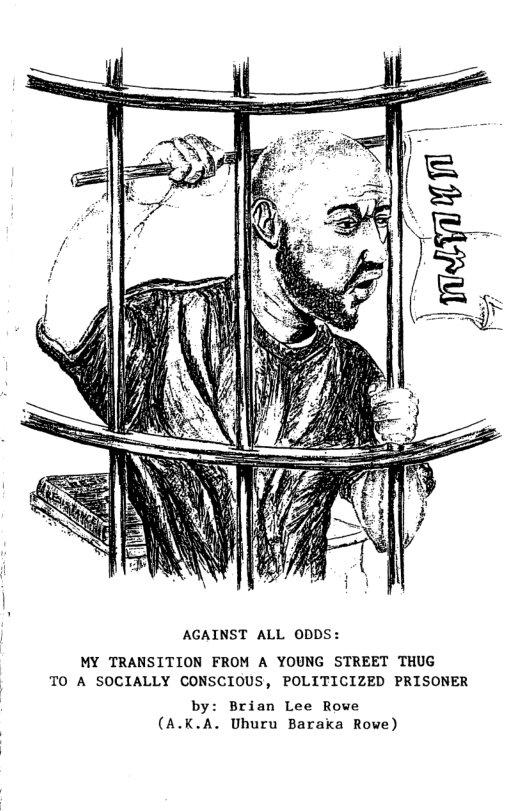
AGAINST ALL ODDS:  MY TRANSITION FROM A YOUNG STREET THUG TO A SOCIALLY CONSCIOUS, POLITICIZED PRISONER  by: Brian Lee Rowe (A.K.A. Uburu Baraka Rowe)
DEDICATIONS  I dedicate this panphlet to those in my family vho passed away during the course of my incarceration: i Robert Lee Rowe, Sr. (March 6, 1943-November 20, 2012) | My father who couldn’t escape his alcohol addiction but possessed a certain strength and determination that allowed ’ him to turn nothing into something and worked hard just 50 his kids could have a roof over our heads, food on the table and cloths on our backs. Some say I look just like you, so whenever I want to see you I’Ll just look in the mirror}  Daryl Peyton Rowe (June 20, 1968 December 9, 2011) | My brother who always lived life to the fullest and was always the life of the party. I looked up to you Bro. I remember the many nights we spent chasing "skirts" together and partying like there was no tomorrow. Life will never be the same without you, but I will definitely keep your name alive, even when others don’t.  Leonardo "Leo" Robinson (Died April of 2008) My mild- . mannered and bright-eyed nephew. I knew there was something different about you the first time I seen you. You had the! potential to be one of the great ones in our family. Sorry ve didn’t have time to bond because of my incarceration, but we’ll have plenty of time to bond in the afterlife. Why the good ones always die so young?  Cousar, TIT and Tameisha Alford (Died July 18, 1995) My two bright and beautiful counsins. I resent the fact that we never got as close to each other as ve could have because of religious differences between our families. After all the time that has passed since you’ve been gone my heart still cries for the both of you. K  TABLE OF CONTENTS  INTRODUCTION. CHAPTER 1 HOW IT ALL STARTED. CHAPTER 2 IN TOO DEEP. CHAPTER 3 THE POINT OF CHAPTER 4 MY TRANSITION  [T we
INTRODUCTION  1 write this pamphlet to both inspire and varn the younge generation of black men and women, that if we do not bioans knowledgeable concerning the grand scheme of this imperialis white supremacist system we call the United States of Amerie: whose main goal is to oppress and annihilate any person of color (blacks, latinos, asians, native americans) then we Wwill be doomed as a people and as a nation. We must beceme intellegent, disciplined mn and women capable of creating great change within ourselves and our commnities. If we do not become the solution to what’s plaguing our communites rather than the probem this generation will be viewed as a failure by the generation that succeeds us. Our familieg and  men and wonen, many of whom are fathers and mothers, being sent avay to prison for decades while their children are lef( to the influence of the "streets",  According to The Sentencing Project the number of inmates in state and federal prisons has increasec seven-fold from less than 200,000 in 1970 to a 1,613,556 by 2009. An additional 767,620 are held in local jails, for a total of 2.3 million. As of 2008, 1 of every 134 Americans was incarcerated in Prison or jail. One in ten black males aged 25-29 was in prison or jail in 2009 as well as i in 25 Hispanic males compared to 1 in 64 white males in the same age group. Adult black males have a 327 chance of serving time in prison at some point in their lives and Hispanic males have a 17% chance. compared to only a 6% chance for white males. Black women represent to fastest growing segment of the prison population. As of 2009, there were 201,200 pomen in state and federal prison or local jails. Fach day in America, 4,302 children are arrested- locked up at such a rate that a Black boy born in 2001 has a 1 in 3 chance, and a Black gitl a 1 in 17 chance, of going to prison in his or her 1ife- time. For decades it has been known that some youths are more at risk of going astray than others But a recent groundbreaking report by the Children s Defense Fund %CDF), entitled "America’s Cradle to to Prison Pipeline," found that, because of fester. ing social and economic disadvantages that exist  1
many times at birth, some black adolescents are not only at-risk- but destined- to end up in prison or die a violent, most likely gun-related, death. "He can look at children from a very young age and based on any number of factors, predict with alam- ing accuracy which ones will likely end up incarcer- ated,", CDF President Marian Wright Elderman says. Edelman says that the fate of a child can be "pre- dicted" ‘early in life.by assessing factors from poverty, abuse and lack of health/mental coverage, poor schools, dangerous communities and little to no quality early-childhood education."The cradle- to-prison pipeline is a man-made disaster," Edelman says, adding that many children "already in the pipeline to prison before taking a single step or uttering a word, and many youths in juvenile justice facilites never were in the pipeline to college or success.” To prove her point, Edelman cites figures that ,, 1 in 3 Black men in their 20’s is under correctional supervision or control. At midyear 2006, about 579,000 Black males were serving senten- ces in state or federal prison, while only 48,000 Black males earned a Bachelor’s degree that year. "What should we expect when states spend nearly three times as much per prisoner as per pubiic school student,” Edelman asked. Indeed, prisons are the new plantations.  In an attempt to shed light on my having fallen victim to cradle-to-prison pipeline and my tran- sition from a street thug to a socially conscious, politicized prisoner, I’Ve chosen to take whoever read this pamphlet on a brief journey from my point of origin as a young child growing up in the tough and gritty streets on the South Side of Richmond, V.A in the late 80’s to early 90’s to where I am at present-serving a 93 year prison sentence handed down by a racist judge for my involvement in a robbery that result in the shooting deaths of two people. It is hoped that through my story of hope- lessness, tradegy and despair to a liberated mind, I can inspire and encourage the next generation and the generation now in existence to educate | themselves concerning the plight and condition of
our people and in the process become the new man and women capable of resisting and overcoming  systemic racism and oppression in all its forms and designs. We, the New Afrikan (Black) Nation,  must become the vangard (front line defense) of our communities.  CHAPTER 1 HOW IT ALL STARTED  My life as a young child reflected that of post black youth growing up within the poor working— class throngs of society. As far back as I coold remember I was always a rebel- a anti- authoritarian. My mother and father would tell me not to do some- thing and T would do it anyway just to prove to myself that I had the heart to do it and could never be controlled. I was so eager to get out into the world and take my rightful place in society. When I was 13 years old, I would break into people cars and rob them for their money and other valua. bles. In an attempt to justify what I was doing, my rationale was this: How dare these people have these nice cars and fancy cloths and I barely have cloths to wear or food in my stomach. I was the product of a working-class family, but because there were seven kids living under one roof, money was aluays tight. Either we had food in therefrigerator 2nd no lights or vice versa. I can remember plenty of days eating 2 nice meal in the dark under the candle light. Or the days we had to use a pay phone around the corner because the house phone was turned off. Occasionally when T would break into cars I would find guns. Lots of guns! It got to the point where I was finding and stealing co many guns I accunulated a small arsenal which I kept stashed under a house we stayed in on Winber Drive. This was a quiet, middle-class section of South Side where there wasn’t too much happening . Nice cars and even nicer houses. If somebody was blindfolded and dropped off on Winber Drive, upon taking their blindfold off, one would think they were in Beverly Hills somewhere. Of course we conld  never afford tobuy a nice house. We always had to rent. But us kids, we didn’t know the difference.  We were just glad we didn’t have to live in the projects. 3
As bad as 1 was, T could never bring myself  to shoot the guns that I had stashed under the  house. In my young mind, I believed what I would  see in cartoons, that if I shot them, I would get  blown back a couple of city blocks by the recoil.  So having no use for them at the time, I would give  them away to the older drugs dealers that use to  hang out on the side of Jack Rabbits (store) around  the corner. I idolized these brothers. They had  the dope cars, cloths and jewelry. And they had  all the women in the neighborhood. I was trying to  gain their respect and acceptance by giving them  guns. It wasn’t long before they let me hang out  on their front porch with them or stand on the  side of the store with them while they sold drugs.  Instead of wanting to be a doctor or a lawyer, I  wanted to be just like them- a street hustler and  a thug, The badest mutherfucker walking the planet.  This was the beginning of my path to no return. Growing up, I was the youngest out of seven  kids. So naturally I was spoiled.If my parents  weren’t willing to get me something that I wanted  I went and stole it. My mother worked night shifts  as a nurse and my father worked during the day as  a forklift operator. He never came home straight  from work. He’d hang out at various cormer stores  getting drunk. I often would run across him at  Jack Rabbits when I went there to play video  games. He would be leaning up against the wall  with one of his feet propped up against the wall  with a bottle of Wild Irish Rose in his hand like  a 0.G. and a Pimp-all mixed into one. My brothers  were all out-and-about doing whatever it was they °  were in to. They would never let me hang out with  them. So I hung out with my three sisters. Where  ever they went I went. They all had boyfriends -  living on the other end of Souh Side in the Oakgrove |  section. We had lived in this neighborhood prior  to moving on Winber Drive. Oakgrove was the complete |  opposite from the neighborhood we had moved to.  Oakgrove had run-down houses, trash floating around |  in the streets, stray dogs running around, the |  smell of urine and the housing projects were just |  1
a short walking distance down the street.There vere many times when my sisters and I would walk from Winber Drive all the way to Oakgrove so they could visit their boyfriends. I would always wonder why their men didn’t drive to pick them up. Especially my older sister’s boyfriend being that she had just given birth to a baby which she had to push in a stroller during our long trek across South Side. I secretly thought that these men were no good for my sisters, and plus my feet use to hurt from all that walking!  A couple of years later when I was around 14 years of age we moved further up Hull Street on Rimrod Road. This was a very diverse neighborhood. There were Chinese, Whites, Blacks, and Hispanics. But it was still the working middle-class nonethe- less. There was a big red brick church right across the street from our house which I use to break-in on the regular and steal electronics. Or sometimes I would just simply break in and vandalize because I was bored and didn’t have anything else better to do. One time when thechurch people was having their service I took a small knife and punched holes in all their tires. It was a predominantly white church so I found pleasure in watching them through my bedroom window as they came out of service and witness what I had done. The look on their faces gave me pure pleasure.  Around this time all but one of my brothers had moved out and found their own place. The brother that remained had just gotten out of prison for a robbery he tried to pull on some white dude when we were still living on Winber Drive. He came home a completely different type of person- withdrawn, angry, lost in pensive reflection. One day when I was just trying to have some fun with him he got up and swung at me with the intention of trying to knock me out. From that moment on I knew it was best that I should him alone- my own brother. Two of my sisters remained and they experienced the brunt of all my picking. I use to set little traps like laying tacks and small nails on the floor so
they could step on them or I would shoot water  at them from my water gun after they had just gotten their hair done or while they were laying in the bed trying to go to sleep. When I wasn’t terrorizing my sisters I would ride around the neighborhood on my bicycle to see what type of destruction I could cause. One day I met up with two white boys down the street the same age as  me. We became best friends. We would steal cigars from the corner store and sneak behind one of the blindspots at the church across’the street and smoke. This was the first time I had ever smoked tobacco. But my two white friends, I could tell they had done this before. They were professionals. They taught me how to blow. smoke out of my mouth and then inhale it back in through my nose. They weré. just as bad as I was. They would talk back - to their mothér and father and even curse at them. As bad as I thought I was. I would never talk back to my parents or curse them to their face, I knew - better. Both my mother and father had hard hands and wouldn’t hesitate to use them. One day when  I got locked-up at school for trying to break into a car while I was skipping school my mother hit me with a hard right across my face and I saw stars for two days. Even to this day after all the Ffights I’ve been in since I’ve been in prison that punch from my mother is the hardest punch I have ever felt in my life. As much as I wanted to change, that so-called "street life" would not stop calling. Instead of skipping classes in school I started skipping the whole day. I would get off the school bus and go right to the train tracks behind the school where I would smoke weed and shoot guns. This was High School and I didn’t want no parts  of it. The group of kids that I hung out with at school all brought guns to schools. When we weren’t- skipping, we would sit in the back of the class and show our guns off to each other. I use to get in 50 much trouble at school that it seemed like the | police was bringing me home almost every day. My mother got so fed up with me that she had me comm- itted to Westbrook Hospital- a place for troubled youth. Instead of seeing it as punishment- I loved
it. Most of the dudes that were in there I knew from either school or from the streets. And plus the food was awesome! Fried chicken, bacon and eggs, hot dogs with chili and cheese . Whatever food you could find in a five-star resturant, they had it. Plus the section for the girls was right across the hall where we could talk to each other. On occasion, they would allow the girls over to our side when they showed movies. Of course there was a lot of touching and smooching going on. I stayed there for about eight weeks until the insurance ran out. I felt kind of conflicted because when it was time for me to go home a part of me wanted to stay. But the other part of me was tired of having to go to all the group therapy sessions wherewe had to talk about our problems. There were white doctors (shrinks) from affluent neighborhoods with their fancy suits and nice cars. And then there was us- a bunch of blacks and poors whites whom they con- sidered a lost cause because we were black and poor and not because of any underlying emotional or psychological issues. And on top of that T wasn’t learning a damn thing but how to sit back and have a good time and have a free ride off of other peoples’ expense. When the day came for me to leave, I kissed the female who had become my girlfriend while I was there, shook hands with my homies;and it was back to the streets.to pick up right where I left off. We moved again shortly after 1 came home. This time to a predominantly white neighborhood around the corner onClearfield Street. I could feel the racism when I come down the block, especially from the old white couple that lived across the street. If was common to see them peeping through their window to see what us "niggers® were up to whenever we made too mich of a commotion outside. I felt like a fish out  of water in this neighborhood. So I would often walk to other parts of the city to see what I could get into. It got to the point where, instead of breaking into people cars to still their poss- essions, I would still the whole car and go joy riding. I thought I was the shit riding around  in other peoples’ cars. I could take a flat-head
and steal a car in under 90 seconds. There wasn’t a person alive who could tell me anything about me and my life and the direction I was headed in. My mother use to always say, "You reap what you sou." I didn’t realize at the time how right she was .  CHAPTER 2 IN TOO DEEP  Eventually the brother that did time in prison had moved out to live with a girl he had met while he was working at Dairy Queen. They would evenutally get married. I actually felt kind of happy for him because she was an older woman and I knew she would keep him out of trouble. The only sibling left at home was the youngest of my sisters. I had stopped terrorizing her at this point because I started to become interested in girls. I use to sit and talk on the phone all day to a couple of white girls that I had met out in Henrico County when I was running the streets. There was this other girl too who I met at a Kingdom Hall which is a church-like place where Jehovah’s Witness go to worship. She was fine,too. Dark-skinned, slim, kind of nerdy. This was the first girl I ever fell head-over-heals for. I mean she had my nose wide open. We use to sit on the phone and talk about getting married and having kids when we got older. But in the back of my mind I knew we would never work. We were too different. I was into the streets and she was into school and building a future for herself. Me, I didn’t know if I would survive the day. On top of it all, not even love could derail me from the path that would lead me to prison or an early death.  When I was around 17 years old, my cousin and 1 wae out joyriding in a stolen car when we got pulled over by the police. We both jumped out and ran. My cousin got away. I got caught. The police could never outrun me. I was still in decent shape from the days when I use to place recreational and High School football. But this day I was high from smoking weed and drinking beer. T ran just one  8
city block and gave up. This chubby white cop tackled me to the ground like he was a NFL line- backer. Because I was a juvenile I simply got re- leased again to my mother like so many times before. By this point I had grown too big for my mother or father to beat me. My mother’s weapon by this point was to look so disgusted and disappointed in me that I literally would feel sorry for hurting her. This arrest slowed me down a bit and eventually I went into Job Corps. I went to a campus way out  in Coeburn, Virginia in the South Western part of Virginia. Klan Toun! The staff that worked there made it clear to us black folks to never leave off campus and venture too far into the surrounding neighborhoods..As hard as I was trying to be in the streets, I imagined that I would be no match for some racist Klan member trying to lynch me by hanging me from some tree. But I would fight to the death, I thought to myself. Job Corps was  just like all the other institutions I had been to before. The food was good, there vere drugs, alcohol, porn movies. Oh, and there were giris. Lots of girls! I was attending school to get a degree in Welding. Life was good for me. I finally felt like I was getting my life on track and for once I was doing something to make my mother proud of me. But as always I found a way to fuck it up. I got  myself into a drug debt with some dudes from out D.C. and they told me that if I didn’t pay by a certain time I was going to get my ass kicked. There was other dudes there from Richmond but they weren’t the type to have my back if some- thing went down. So T felt compelled to break into the canteen that was there to steal some boxes of cigarettes to pay my drug debt. I ended up getting caught as always. The staff called my mother and told them to come and get me because I was being expelled. My mother drove all the way from Rich- mond to tne Flatwoods Job Corps Center in Coeburn to get me. The strange thing was that she didn’t even look mad or disappointed. By this time I figured she had gotten use to all my mishaps with the lav. She had lost faith in me andany hope that she had that I would eventually turn my life around vas gone.  9
During the five months that I spent in Coeburn Job Corps my brother Daryl had moved back home,  and with him came the beer. I had slowed down on  my drinking by this point. But Daryl was like our father- the day wasn’t right if they weren’t in- toxicated in some type of way. So looking up to  my brother I started back drinking. I was only  17 years old. I could drink a whole 40 ounce of  01d English 800 in ten to twenty minutes. After  we got drunk, we’d call our cousin to come  and pick us up so we can go out riding. He had a brand new candy apple red Ford Probe with the booming system and a bad ass wife. I wanted what  he had. So I went and got me a job at Dairy Queen flipping burgers until I saved up enough money to buy my own car. I paid $800 for a 1985 Ford Escort - Wagon that had silver five-star rims. It was no Ford Probe but it was mine and I didn’t have to Jump out and run whenever the cops pulled up be- - hind me. It was a four speed manual shift which  1 didn’t even know how to drive. After my father taught me how to drive it I was gone in the wind. Me and my partners would ride’every where= Virginia Beach, North Carolina; we even’ drove to Tennessee one time. It wasn’t long though before my car be- came a tool whereby I could commit crime more efficiently. Instead of robbing and stealing and having to run away on foot I could now drive away in my car. By this time I was deep in the stick- up game. We would drive out to all the counties and ‘rob them county boys for their gold chains, rings and what little cash they had in their pockets. It was during this time I met this girl who turned my world upside down. She was different from the other girl I had fell in love with, mainly becuase she always gave me some excuse not to have - sex with me. But this girl, we would make love on the regular. She would get up in the morning to. | cook me breakfast. Up until this point I had never 1 known love like this before. It was almost like  we were married. After a while, I ended up moving 1 in with her. Every chance we got we would have sex. We couldn’t keep our hands off each other. She was a good girl- faithful, loyal, passionate, considerate.  10
and extremely experienced in the art of love-naking. She taught me many things about making love that even I didn’t know. She was three years younger than me but I could tell that she was way more mature than I was. Our relationship was new, ex- citing and refreshing and a strange thing started to happen to me. Instead of feeling anger and rage I begin to feel joyful and happy. I would sit on her front porch and notice the beauty in the way leaves would fall from the tree or theway the flowers would move to and fro as if dancing to the tune of the wind. I started to feel alive for the first time in my life. Not only was we in love butwe vere infatuated with-each other: As much as I wanted it to last I knew deep down inside that such love is not meant to last. Plus there was danger lurking nearby that would come and  snatch me by the collar and throw me into the pits of hell.  CHAPTER 3 THE POINT OF NO RETURN  My drug use increased a few weeks after I met my new love. Instead of just smoking weed,  I was now sniffing heroin and drinking hard wine. I went home to my mother’s house so high one day I started hallucinating. My father took me to the Hospital where I stay over night under observation. About a week later my mother convinced me that I needed help and so I ended up going to Central State Hospital, a hospital for people with severe psychological and emotional problens, and where people go who have been found not guilty by reason of insanity by the courts. This.place wasn’t like Westbrook Hospital for boys and girls with minor problems. This was a hardcore adult psychological institution. The people confined here were schizophrenic, delusional, had multi- pal personality disorders and were bipolar. Now 1 considered myslef crazy but I wasn’t THIS kind  of crazy. These people were walking around talk- ing to theirselves, drooling from the mouth,  completely withdrawn from reality and zapped- out on hardcore psych meds.  11
vo gome and get me out of this hellhole, Abous a veek later she came and got me out. There woe a gondition I had to agree to,though, and thas con- dition was that I had to agree to go to Rubjeon  prison for crazy people. When I got to Rubicon and saw how lax the’security was I knew that I  could just walk out the front door. Rubicon was just a haven for drug and alcohol abuse. I sau drug needles and empty beer cans all over the. floor. 1.could tell this place didn’t receive much fun. ding from the city. The walls was dirty and the building itself looked like if you blew on it it would fall down. Upon close observation I could tell the patients from the staff. one of the statfers wp checked me at the door had on ragedy cloths, hew eyes had dark circles as if she hadn’t slepi in ueeks, and she had dirt caked under her finger nails as if she hadn’t bathed in days. The chair I was sitting in was facing Hull Street and I could see people walking back and forth and cars driving by. Freedom was just a few steps away. 1 wanted to do the right thing and stay to get the treatment that I so badly needed but I couldn’t resist the temptation to get up_and walked out. When I left out the front door I could hear some- one from the top window yell at me, "Hey, where are you going,”. I ran as hard as 1 could until my body couldn’t run no more. I went and got my car and picked up my comrades and I was back on the streets. As much as my mother tried, ther was nothing she could have done or said that could have convinced me to straighten my life up. I was focused on one thing- destruction. Either some. body else’s destruction or my own. Instead of giving away my the guns that I found to the older hustlers on the block I started carrying them, Guns, drugs, aleohol, and a bunch of trigger -happy Woung  12  | | |
black boys. It was all a bad combination.  Eventually I quit the job I had flipping burgers at Dairy Queen. I got tired of slaving over a hot stove for minimum wage. Even though it felt good getting a check with my name on it, the money wasn’t enough for the wrk 1 had to do to get it. After three months after I quit my job my car broke down. Out of a car and no money in my pocket, I went back to what I was good at- robbing. By this time I had met this dude who was as cold- hearted as I was. He was much older than I was. He showed ‘me and my homeboys how to rob stores, banks and other commercial businesses. So we graduated from pulling small time robberies like breaking into other people cars and steeling their money, to pulling big time robberies.  he first big time robbery I pulled felt like I was doing something I was born to do. It felt so natural and easy. The money that came from it gave me an even bigger high than what I was getting smoking weed. It was some restaurant out in the county. We marched in four deep and pulled out our weapons and said, "Stick up. Everyone down on the floor." There was about ten people on the inside. After we robbed everyone for their momey we started to run for the front door until I heard this voice that told me to turn around and shoot. I turned around and aimed my pistol at the clerk and_then I squeezed the trigger until all the bullets were gone. I didn’t even wait to see the body drop. When we got back to our getaway van one  of my homeboys who witnessed the whole thing started crying to my surprise! He was one of the guys we all considered to be the hardest out of us all. Tt became dbvias to me that even though he liked to carry guns he hadn’t shot anybody before or seen someone else get shot. Even I was a little shaken up. This was the first time I had shot somebody. While my comrades were crying and over- come with fear, I felt good about what I had done, and I relished in the moment because all who knew me would know that I wouldn’t hesitate to kill if it came down to it.  The next day everyone was giving much respect and admiration because of what I did, which,in turn, fed my ego and lust for more destruction.  13
The drean that I had when I was younger of being one of the meanest, cold-hearted mutherfucker to ever walk the planet had finally become my reality. In an instant, I went from being a small time car thief to a cold-blooded murder. I now had blood on my hands and I had come to the point of no re- turn.  Around this time the marriage between my mother and father was coming to an end. Actually it ended many years ago but they tried to work it out for the sake of us kids. My father was having an affair with another woman who stayed in the apartments beneath us and my mother got to the point where she was tired of every thing- tired of being married to a chronic alcoholic; tired of the us kids driving her crazy; tired of working hard but never seeming able to make ends meet; just sick and tired of being sick and tired. My father moved out, and upon loosing the apartment we stayed in because my mother couldn’t afford to pay the rent by herself, we moved in with my brother Daryl and his "wife" down on Joplin Street up the hill from the Hillside Court housing projects. Every- - thing my mother and I owned yere either in the back of her car or in storage. Witnessing first hand how my mother had wrkad hard all those years 50 us kids could enjoy a certain measure of comfort, and witnessing how much she invested in her marri- age trying to make it work, to see it all come crumbling down, I felt tremendous sorrow for my mother. Instead of being there for her like a son should in her time of need, I was still hanging in the streets and chasing behind my girlfriend. All - this took place at the end of 1994 and by this time T had pulled countless robberies. Its quite possible that I robbed every business on Belt ) Boulevard and Jefferson Davis Highway. When my old Ford Escort Wagon broke down I knew I had to get some more money so I could buy me another car.  Through one of my homeboys I met, this dude who was just like me- a cold-hearted, rebellious,  | | |  14
homeless teenager who didn’t give a fuck about anything or anybody- not even himself. The first time I looked into his eyes it was as I vas Star- into the eyes: of Lucifer. I could tell that he  was full of rage and was ready to unleash his pain at the flip of a switch. All the other dudes was scarred of him because they thought he was crazy. I embraced him like a brother. We hung out all the time together. If you seen one of us, the other one was surely some place nearby. The relation- ship I wish I had with my real brothers, I found in him. There were many nights we were layed-up in the City Motel with some girls we had picked up at a club or off the streets. By this time the relationship I had with my girlfriend was all but over. She was a good girl but she was in love with a bad boy. She tried to get me to stop living this so-called street life. I could tell that she really cared for me every time I looked in her eyes and the way she tried to hold on to me when I would leave out the front door to go run the street- but it was never meant to work. We were from two different worlds, she and I. She was an honor student and a cheerleader in highschool with a promising future zhead of her. Me, I was a high- school drop-out, a drug addict and alcoholic, my spirit tormented by evil things I had done, and my future looked bleak. Either I was going to end up dead on the straet or sent to prison for the rest of my life.  She held on tight onme fateful night as I was leaving out the front door. In fact, she begg- ed me to stay with her. It was as if she could see into the future and knew something bad was about to happen. She’d heard of the rumors of all the things I was doing in the streets. Maybe it was because of the guilt she was feeling from enjoying all the money I would give her that kept her from asking. The look in her eyes as I pull- ed avay tore my soul apart. This was my queen, my love, the girl who I wanted to marry when we got a little older and got out money right. I couldn’t look soft, though. My comrade was watching from the car. I had to be tough. I had to be a man. I walked away from the sweetest, most innocent thing T had ever known.  15
So there we were- me and my comrade and some other dude he brought with him from the North Side of Richmond. I didn’t know him nor was I trying  to know him. Whenever I looked at him he would look down towards the ground to avoid eye contact. Something seemed fishy about him. I ke T cauldn’t trust. him. T had to keep my eyes on him. My comrade started having second thoughts. “Let’s chill out for a while," he said. "We’re too hot." But T wasn’t trying here what he was saying even though I knew deep done inside he was telling the truth. They looked up to me. I was theit leader. I could have stopped our late-night mission. I should have known better, but I had money and biood on my mind. There was no room for weak shit. I looked at my comrade while he was driving and for the first time I could see fear in his eyes. Underneath his tough exterior, I could see his vulnerability. He was driving much slower than he use to as if he was buying time so that someone would come rescue us from our imminent demise. But nobody rescued us and suddenly we found ourselves standing out- side the store- ready to make our move. At the last minute my comrade’s friend got cold feet. "I’m not cut out for this,” he confesses. So my comrade chastise him severely before sending him back to the car. "Are you ready,” I ask my comrade. He looks at me with a cold stare- the fear ‘and vulner ability no longer there. "Let’s do this,” he commanded with a low, but determined tome. “This is a stick-up, put all the momey on the counter," I exclaimed with a loud, commanding voice. In an instant I blanked-out and when I regained my wits there were two deads bodies on the floor. Me and my comrade ran the hell up out of there as quick as we could. On our ride back to Gilpin Court hous- ing projects on the North Side we were all quiet. The only noise being made was the music coming from the radio. Each one of us lost in our own thoughts, reflecting on the horror we had just committed. As I layed in the bed that night, looking out the window at the rain beating down against the ground, suddenly T felt Filthy and dirty, as if T had been  16
rolling around in a underground sewer. The smell of blood and gunpowder ceated the inside of my nose which caused me to feel as if T had to vomit. My cloths smelled of beer, cigarette smoke, and sweat. In the quietness of my mind I hear the likeness of my mother’s voice calling out to me saying, "Drian, come home to me." I closed my eyes to clear my mind, but I suceeded only in passing out from all the beer I had drunk and the weed T had smoked earlier that morning.  The next day, I went and leased a used 1994 blue Honda Accord with the money I had taken from the robbery. I put down $800 cash money for it. The car dealer looked as if he was a crack addict. His cloths were dirty and his skin was greasy. When I pulled the money out of my pocket for the car his eyes damn near popped out of his head. He handed me the keys to the car and I was on my way. Though the Honda was used, it was in fair condition and a big improvement from the old, beat-up Ford Escort Wagon I had previously. My comrade and T took his friend down to the Hillside projects so he could pick up his little son from his baby’s mother house. The two of them drove in my comrade’s car and I drove in mine. My comrade and T sat out- side while his friend ran in to get his son, which was a bad idea because Hillside Court during this time in the late 80’s and early 90’s was a war- zone. There was a murder committed here almost daily. Though T was intoxicated, I kept my eyes open wide as I tightly gripped my .357 revolver 1 had sitting on my lap. We waited outside for what seemed like an hour. Something didn’t seem right. "Why is it taking him so long to run in and get his son,” I thought to myself. I felt anger, rage and paranoia starting to build up in- side of me. "I don’t even know this dude. Why am 1 putting my life in danger for him,” I thought to myself. I take a few puffs from ablunt I had sitt- in my ashtray since that morning. Suddenly the anger and rage subsides but the paranio remained. Finally he comes out the apartment with his son and makes his way back to the car; but not before he turns around and gives his baby’s mother a kiss and a delicate smack on the ass. I envied him at that moment because I wantedto be with my  17
girl. I yelled to my comrade that I had to make  a run and so we parted ways. What I really wanted to do was go and check on my girlfriend to see if I could save our relationship. Though I would never say it our loud, I loved this girl more than I loved the streets. There were times when I secretly wished I was with her enjoying the tender atfect- ions of her kisses rather than driving around pull- ing robberies. I pulled up to her front door and to my surprise she came running out to me as if she hadn’t seen me in a hundred years. We spent  a couple hours talking about our future together and about the cause of all that was going on in our relationship, Which we both agreed was my thug-life persond and my addiction to alcohol and drugs. T vas only 17 years old and I was a full blown alcoholic. I have come to the conclusion that my father taught me three things in life and that is: 1) how to work hard, 2)how to drive a four speed stick shift, and 3) how to get drunk and have a good time. His drink of choice was Wild Irish Rose. When I was growing up I would always find his wine stash that he would hide around the house or out in the garage. I would take a ip or two just so I could experience what he was feeling. One time I ended up drinking a quarter of a bottle I found under his matress and ended up getting so intoxicated that I ran around acting life a fool that whole day. Of course, acting like a fool for me was normal So no one knew the difference. My father would come home so drunk he -couldn’t tell one son or daughter from the other. There vere many days where he would call me Daryl or Lisa (my old- est sister). Us kids would often find him to be quite comical when he was in his drunken state. Even our mother found him to be humorous at times. However, when my father was sober, he wasn’t very pleasant to be around. When he vasn’t intoxicated he was a vicious, angry and bitter man who ruled with an iron fist. I vaguely remember one day when I tried woldeartally to engage him in some father-son conversation while he was working on the family car, he turned around a gave me a hard punch across  18
ny face, and told me to get away from him. There were times when I had to literally tip-toe  across the floor of the house just to keep from provoking him to inflict one of his rage-filled beatings upon me. As bad as a father he was to me I never could bring myself to hate him. Even as a young child I understood that he was suffering from some type of deep-seated emotional issues as a result of some childhood trauma he experienced and the only way he could cope with it was by gett- ing drunk. I felt nothing but pity and love for hin even though I knew he was incapable of loving me back. When I found out he died November 20, 2012, T felt a tremendous amount of guilt because I managed to shed only two tears.  My girlfriend and I were engaged in a long, passionate kiss on the front porch of her house when my comrade and his friend pulled up in his car. We had bought new sound systems for our cars earlier that day and we took the time to hook them up in the front yard of my girlfriends house before we took to the road. We both agreed that it would be best to get out of town for awhile until the heat blows over from the last robbery we pulled. My girlfriend came to the door and told me that my mother was on the phone and so I went in to talk to her. She said she was afraid for me hanging out in the streets all day and that she wanted me to come home for awhile. I told her that I would be home in thirty minutes.  My mother was seperated from my father during this time, and being the youngest out of seven children, all of whom had moved out on their own, I was the only thing my mother had left- besides my brother whom she was staying with. As bad of a child I was, I hated to disappoint my mother. So when there were opportunities I could cause her some comfort and peace of mind, I jumped at it.  My girlfried intercepted me at the front to give me a kiss goodbye for the night. I loved the way her lips felt on mine. They felt like heaven and made it seem as if time stood still.  19
We held hands for a moment talking about what we would do the next day. With all the shit | had gotten myself into I knew that our time to- gether was limited. We kissed ome last time and when my hand left hers I knew it was the last time I would feel the tenderness of those hands again. On my way back to the car, out of no where, about ten police cars surrounded me, my comrade and his friend. One police officer ran up behind me and pressed his 10mm Semi-Automatic pistol to the back of my head and told me if I moved one inch he would blow my head off. This fat blackcop came from out of no where, grabbed me by the collar of my shirt and threw me down to the ground with such force that I was nearly knocked uncomscious. The white cop was looking at the black cop like - he had gone mad. This situation reminded me of some- thing I’read years later in a book called "Soledad Brother" written by the late-great George Lester - Jackson; a brother who had become politicized in the California prison system, became a Black Panther, revolutionary prison activist and author. Jackson was assassinated in the prison yard of San Quentin in - an alleged escape attempt August 21, 1971. In Soledad Brother Jackson stated "The black cop could be a large factor in preventing our genocide. But no help can be expected from this quarter. The same stupidity and desperation that brought him to the gates prevents from interceding. The job, the wages means too much to him. Often he feels compelled to prove himself, prove that he is loyal to the force, prove that he is not prejudiced in favor of us, Prove that he is honest. His honesty prevents him - from dealing in contraband as every white pig does. The same fear will cause him to show more zeal in the "club therapy” sessions [police beatings] than even the whites manage. If the victim is black, he he is going to get so mad that white pigs [police] will have to stand back and let him swing. If they dont have murder planned for that session, they will have to pull that nigger off you." From the look in this black cop’s eyes I could tell that he wanted to kill me just to appease his white counter-  20
art. I still remember the look of jubilation as e slapped the cuffs on me and put me in the back of the white cop’s police car.  So there we were- the three of us- me, my comrade, and his friend, headed down to the police precinct. It was around 12 o’clock in the morning. We were taken to a back room where all three of us were seperated. Seperation is a tactic often used by the police when there are multiple suspects to inspire disunity and suspicion. It is often called divide-and-conquer. The police will often tell each suspect that the other is already cooperating with the investigation, which is almost alvays a lie, with intent of getting that suspect to confess. After the investigation was over I was labeled a leader of our group and it was re- vealed that my comrade’s friend, Antonio Crews, called Crime Stoppers while he was in his baby’s mother apartment and tipped them off to the robbery and murder we had committed. He even provided them with my girlfriend’s address so the police would know where to come and arrest us . In the end, my comrade and I were charged with two counts of capital murder, robbery and three gun charges. Crews testified against my comrade in exchange for having his murder charges non-processed and would spend only a year in prison. My comrade was con- victed by and jury and sentenced to life. To avoid Crews coming to testify against me at my trial, I plead guilty to two murder chages, robbery and gun charges and sentenced to 93 years in  the penitentiary. The whole time my comrade and I was sitting outside in our cars down Hillside Court waiting for Crews to come out with his son he was on the telephone with the police setting us up for the fall. Knowing this left a bitter taste in my mouth for many years.  I was down the Richmond CityJail, this time in 1995, locked-up with hardened criminals. I spent my first day trying to get adjusted to this new en- vironment. The time I spent a Westbrook and Cen- tral State prepared me for the jail. It is all a form of control. I started reading the bible and  21
praying like most prisoners do hoping that God would come and rescue me from my situation and give me another chance. But God never came and I knew  I had to make the best out of a bad situation. ALl T could do was think about my mother ‘and the pain and disappointment that I had brought upon her. Even in jail, facing the very real possibility of spending the rest of my life behing bars, I still was a rebel. This one dude came in the dorm making plenty of noise early in the morming while other inmates were trying to sleep. About 30 in- mates jumped on him. So, trying to make a name  for myself, I jumped on’him too. We beat this guy  to a pulp. The jail guards came and dragged him  off the dorm. Then they came back to find out who the inmates were that was involved in the beating. Nobody said a thing. During the nine months I spent down the City Jail I became good friends with this older brother named Shandu. He was much bigger and a couple of years older than myself. ‘ By the time I came down the jail he had already built a reputation as being one of those dudes other inmates didn’t want no problems with. When he walked around the dorm, other inmates made supe to move out of his way. e would beat up the in- mates who were from New York and take their comm- issary. Whenever his girlfriend didn’t come to visit him as promised, he would get mad and walk aound the dorm and knock-out other inmates with  one punch just because he was pissed-off. All the inmates on the dorm was scarred of him. I was the only one brave enough and smart enough to make him ny friend. In the summer time it got so hot on the dorm that I could literally see steam coming off of my body. I made quite many friends on the dorm. I vwas well known because of my case being repeatedly advertised on the news. T would play cards all day or do pullups and pushups so I could get myself in- to shape. I was only 145 pounds soaking wet. Or I would lay in my bed and read the Bible, which is what a lot of inmates do,hoping and praying that T would be able to survive this environment. Or I would sit back and watch Shandu terrorize the other inmates on the dorm. I was amazed at how much fear  22
he put into the hearts of the other inmates. He was big and menacing and knew how to use his hands in a fight. But this fear that the other inmates had of him would  prove to be his down-fall in the years to come. I looked up to him, sort of like a big brother and he embraced me just the same. And a lot of other inmates gave me respect just because of this. They knew that if they had a pro- blem with me then they would have to deal with him too. So I got away with doing a alot of shit that 1 knew I would not have gotten away with if me and Shandu were not cool.  Later that year in September of 1995, the hmeant for me to get transferred out from the jail into the prison system where all the hard-nosed comvicts were at. A place where there were inmates who had already been in prison twenty or thirty years. I had already heard about the stories about what goes on in the penitentiary- the rapes, the stabbings, the murders. No other inmate will openly admit this but when I was on that bus headed for the penitent- iary, I-was scarred and I could feel my heart- beating a humdred miles a second. I had made my mind up that if another inmate tried anmything with me, I was going to kill’em without any hesitation.  When I entered the prison system this seemed familiar territory to me. I had been in other in- stitutions before. All institutions have one fund- amental function and purpose and that is contain- ment, Keeping the social misfits of society from speading to the more affluent, mostly white middle and upper-class neighborhoods. This is one of the reasons section 8 housing projects are never built in the suburban or rural areas. They are almost always built in urban inner-city neighborhoods populated by poor non-white minorities.  At the Brunswick Correctional Center in 1996 I ran across some revolutionary minded brothers. Mentally, these brothers were sharp. I would sit and listen to them talk about racial pride, black power, politics, and how to overcome the oppress- ion of the black man by a white-supremacist polit- ical/educational/economical/cultural system.  23
L was in my late teens and I heard never heard about the things these brothers. were talking about. These brothers were disciplined, militant, snd when they valked, they walked with ajthority, pride and putpese - But there was a darkside of the penitent. iary, that sector that would lure the weaker smmates that did not alrexy have the proper guidance. Thepe were open acts of homosexuality. I witnessed many younger- and somethimes even older- .inmates ¢ome in and get turned-out. The homosexuals would look at us younger brothers coming into’ the prison syst- em as potential victims. Many of these brothers in the "punk’game vere weak-miindedor was already on the "down low" before they even came to prison. I wit- nessed how some of these dudes lay in the bed with an ther man and have sex and then go over to the visitation room and kiss their wives or girlfriend in the mouth. It was all sickening to me and I new that this was a world 1 wanted no parts of.  This older brother name Fred gave me a book to read called “Black on Black Violence- The Peych- odynamics of Black Self-Annihilation in Service of White Domination” written by the great revolution- ary black author/psychologist Amos Wilsom. This book stated that "The black on Black violent crim- inal hates in other Blacks those characteristics he hates most in himself. His expressed contempt for attacks on other Blacks are the means by which he refrains from recognizing and expressing his self-concept. By externalizing his self-contempt he stays his own hand from attacking himself. He commits homicide to keep from committing suicide. His homicidal mania, violent rages, are curious and perverted forms of self-preservation. He is compelled, therefore, to externalize his self-con- tempt, to blame, berate, humiliate others. This, however, throws him in a toil of a vicious circle. The more he despises others the less he is aware of his self-contempt- and the self-contempt grows more violent and merciless and the more hopeless he be- comes. To strike out at others is then a matter of self-preservation. Having accepted the notion pro- mulgated by his White oppressors- that he will never  24
measure up to their...standard, never be as good as they- he vindictively asserts that they will never be as ’bad’ as he. Thus, he finds near ero ic delight in demonstrating himself to be the ’bad- dest’ who ever walked the earth. In this game he had a better than a sporting chance to win.In this game he makes the rules. The essence of the Black on Black criminal is self-hatred or self-alienation. These can occur as the result of the self having been made to apprear to be hateful, ugly, degrad- ing, rejected, associated with pain, non-existent or devoid of meaning, and inherently inferior. Such appearances and associations are the fruits of White American narcissistic racial projections against the Afriacan American community". Wilson states further: "As the controller of information, the ’validator’ of truth, ministers of education and instruction, role model, chief reinforcer, as the Final Word and ultimate authority, it is the White American community that must bear the re- sponsibility for injecting as the central motivat- ing factor self-hatred, or more accurately, self- alienation into the heart of the Black on Black criminal and the minds of the rest of the maladju- sted African Community.The Black on Black Crimin- al is what he is because he has been treated crim- inal at some crucial point in his life, and/or treated to a history or model of criminality. He is within a context that evokes or instigates criminal behavior not inhibited or redirected by effective opposing or alternative moral, intellect- ual, socioeconomic, cultural and valuation struct- ures. The Black on Black criminal is violent be- cause he has been violated, or perceives himself as such. He is vindictive. He wants to ’pay the world back’ for some insult which may have result- ed in his having been conceived and born; an in- sult which occurred to him in the womb; an insult for which occurred centuries before he or his par- ents were born- a history of unrequited grievances."  The reason for my being a rebel all became clear to me. Everytime I squeezed the trigger of a gun T was trying kill that part of myself which P nas  25
taught to hate: my thick nose and 1ips, my brown skin complexion, my kinky hair. After all the years I spent in school, this was the first book I’read front to back. I’had never read anything like this before. It was revolutionary and it made me think about my life and all the things I had done. I realized that I was a pawn in a game where I was programmed to destroy mysélf and my own people. I learnt more in the 9 days it took me  to read this book than thé entire 19 years I had been in existence. Public schools- or what pass as as in the urban minority communites- are not designed to Liberate , the minds of black children; they are not designed to teach us about our true African heritage that pre-dates the trans-Atlantic slave trade, and that we, the black Africans,were the original people on this planet, and the fact that we descended from Kings and Queens; they  are not designed to teach us bos tote entreprenuers-  * owners of businesses and land. All they succeeded in doing was teaching us how to stay in our place, . to accept being a dominated, oppressed, lower-class people and how to remain 20th Century slaves in service to a white-supremacist capitalistic system. The more I read about my culture and politics in general I started thinking different. I started feeling empowered. Instead of walking with my head down, T started walking with my head pointed to the Sky, with my back straight, shoulders pulled back. I started walking with purpose. I began to have pride and began to see it as a privilege to be an_African. Instead of feeling ashamed when- ever I came in contact with white people, I start-" ed looking white people in the eye instead of hold- ing my head down as if I was still a slave; because 1 was equipped with the knowledge that I descended from a people who had existed on this planet long before the white man came into existence. When the white man was still dwelling in the caves of the Caucus Mountains, Afrikans had flourishing kingdoms like Timbuktu (in present day Mali), Nubia (an acient kingdom in the Nile River Valley of South Egypt and North Sudan), Cush (Kush) (an ancient Kingdom of Nubia in North Sudan which flourished from the 11th century B.C. to the 4th century A.D.)  26
and the famous Ancient Egyptians. I’m talking about the original black Egyptians like Cleopatra who was an Egyptian Queen back in 51 B.C., Nefertiti who was an Egytpain Queen back in the l4th Century, and Akhenatom, also known as Amenhotep the 4th, who was Egyptian king back in 13757 B.C.- not the white, pale-skinned Egyptians we see on the television played by white actors who try to brainwash us into believing the Ancient Egyptians were white. When the Greeks first traveled to Africa 2,500 years ago, the Egyptian civilization was already ancient. The Great Pyramid was over 3,00 years old and the sphinx was even older. Writing, science, medicine and religion were al- ready a part of the civilization and had reached their zenith. The Greeks came to Africa as students to sit at the feet of the Ancient Egyptians and to discover what Africans already knew. In any student/teacher relationship the teacher can only teach as much as the student is capable of under- standing. Egyptians, like other Africans, under- stood that life existed beyond the grave. Ancest- ral worship is a way of acknowledging the lives of the people who have come before you, and their ability to offer guidance and direction to the living. Temples were designed as places where the ancestors could be honored and holidays (Holy Days) were the days designated to do so. The Egyptians had hundreds of temples and hundreds of Holy Days to worship their ancestors. The Greeks thought the Africans had a preoccupation with death. The act of ancestral worship becam e known as necromancy, or communication with the dead. The root word necro means dead. Another word for necromancy means magic- that Old Black Magic which was practiced in ancient Africa. When the Greeks returned to Europe, they took their distorted be- liefs with them and the word negro evolved out  of this great misunderstanding. Less than 300 years after the first Greeks came to Egypt as students, their descendents returned as conquerors. They distoyed the cities, temples and libraries of Egyptians and claimed African knowledge as  27
as their own. Not only was the African legacy stolen, but the wholesale theft of African paople soon followed. With the birth of the slave trage it-bacame necessary to dehumanize Africans amg c’ devalue their historical worth as a people in order to ensure their value as slaves. So there you have it, the negro- a race of dead people with a dead history and no- hope for resurrection as long as’ they remainded ignorant of their of their past. This was a triple death- the death of the mind, -body, and spirit of the African people:  For a while it felt good to learn something new-’something that boosted my self-esteem and self-worth. But my transition from that street thug I tried so hard to be on the streets was far from complete. When I first came to’prisen the inmates were segregated along geographical lines. The Norfolk inmates stayed to themsélves. The D.G. * inmates stayed to themselves. The inmates from Northern Virginia stayed to themsélves. ‘And of course us Richmond inmates- we were a whole differ- ent story. Each group wanted ’to prove that their city went the hardest and this’created a lot of tension. In the early 90"s Richmond was the murder capital of the whole United States. This little, tiny city averaged 150 murders a’ year. Richmond itself was’ devided along’geographical lines. Theré were a“lot of terf wars’ going on be- tween South Side, North Side; West End; and East End which was inspired, in large part, by the rise of thé crack epidempic which swept across every hood, ghetto, project in the nation during the {ate—so‘s and”early 90’s. In the prison system, inmates from’Richmond was the most feared due in large part to our potential for violencé and:the fact that we out-numbered inmates from other areas five-to-one.’ Whenever a fight jumped”off that in- volved an inmate from Richmond, we would all get involved:® There were no’such thing as fair fights as fat as we weré concérned. And dam near all of us were serving’ 50, 60, 70, and life term prisbn sentences; We were young, wild, angry, and hope-  28
less with nothing tc lose . One day while I was laying in my bed watching the news, I learned that a riot had jumped off at the Greensville Correctional Center between inmates from Richmond and D.C., and that Shandu, the older brother who  I looked up to as my big brother while I was at the city jail, was stabbed to death on the recre- ation yard. It felt like someone had hit me in the stomach with a bag of bricks. I had developed a certain love for this brother and he was well known by most of the inmates from the South Side of Richmond. Soon the word spread about his death and we wanted to do something about it. When we learned that inmates from D.C. were bragging about his death, we knew what we had to do. About twen- ty of us young brothers from Richmond approached a group of D.C. inmates as they were coming from the cafeteria and started a fight. We outnumber- ed them 2-to-1. They didn’t have a chance. Even though none of them were stabbed or killed, we PUt a real beating on them that day. One of the prison guards came and snatched me and two of my conrades up, put us in cuffs, and locked us in a cage with five other inmates’ from D.C. who were not cuffed. We later learned that those five  D.C. inmates had homemade knives on them and didn’t even use them. To this day I believe the prison guards wers trying to set us up to get stabbed or possibly killed. We all ended up spend- ing six months in solitary confinement- locked  in a single cell twenty-four hours a day. If it wasn’t for my radio, I probably would have lost my mind. When I finally got relased back to gen- eral population, the older brothers who had in- spired me to start reading, were very disappoint- ed with me. They didn’t condone any type of black on black violence. But T wasn’t ready to be a disciplined soldier in the struggle just yet. In the three years I spent at Brunswick, I accumul- ated nearly fifteen irfractions (writeups) for disobeying prison rules and regulations. 1 was  80 out of control, that when the newly built super max prison, Sussex Ome State Prison, was opened in 1998, I was among the first group of inmates to be transferred there.  29
Sussex One State Prison represented a new form of control. It was built to house the so- called "worst of the worst." We were locked-down in our cells most of the time and only came out when it was time to eat or when we were allowed to go outside, which was once every three or four days. Control movement was enforced to the ‘max. We were forced to stand by the wall whenever we came out our cell to eat and we had to walk in a single file line along the designated yellow lines  painted  on the ground. The guards here were allowed to possess shotguns loaded with both lethal and non-lethal ammunition. Whenever there was a fight or if inmates refused to walk along the yellow lines on the ground, the guards, both black and white, would point the shotguns and shoot indiscriminately. On a number of occasions I witnessed inmates get their eyes shot out  by bouncipg rubber pellets. Any inmate who was not fast enough tq run back in his cell or duck behind a wall when the pigs started’ shooting would potentiaily get shot. Thiswes torture and in- numane treatment at its best. Whenever I stepped out my cell I always stayed near my cell door so T could quickly duck back inside if the trigger- happy guards started shooting.  After a year had gonme by after first arriving at this so-called super-max, I was approached by this inmate from Compton, California  not much older than myself at the time. He told me that he was visiting his family in Virginia when he got caught-up, in a drug bust. He told me he’d been watching me for a while and that he liked the way T conducted myself in a militant fashion. He told me that he was 3 Blood gangmember and that he wanted me to be a part of it. I already had previous dealings with this "organization" prior to my coming to prison, but didn’t have a whole lot of knowledge concerning its history. At first 1 declined. his offer because I already considered myself to be a so-called gangster. But the more me and this brother talked, and the more he told me about the history of the Bloods, the more L became interested. As far back as I could remem- ber, I always wanted to be gangster. So here was  30
my chance to be a "real" one. So I got "mad and became a Blood in the summer of 1998 and was given the name B-Love, short for Blood Love. What I didn’t know was that I officially entered into a life-style that could cause me to get more time added_onto my sentence, or worse, get me killed. This life-style put me directly in the middle of a conflict between us inmates who claimed Blood (there were about 5 of us) and those inmates who claimed Crip (there were about 4 of them). There were a lot of blind spots on Sussex One if you knew where to look. If an inmate got caught in one of those blind spots and another inmate wan- ted to do something to another inmate, that in- mate could easily get stabbed without anyone knowing who did it. Such a place was the steps (staircase) leading from the first floor of :F.e building to the second floor. One day after we were on our way back to the dorm after eating lunch, I, along with two other Bloods)got into a conflict with two Crips on the staircase. ALl of us Bloods were in good shape. We exercised faithfully in the dorm every morning. The Crips didn’t have a chance. During the midst of the fight, one of the Crips pulled out a razor-blade and slashed the Blood that was standing beside me on his forearm. I gave him one good punch to the side of his head nafing him drop his blade to the ground. I reached down, picked the blade up, and was about to slash him with it when we heard the prison guards run- ning down the steps from the third floor. We all ran back to our dorms as fast as we could to avoid being placed on solitary confinement. The Blood that got cut ended up going to the hospit- al to get stitches for the cut on his forearm. When I got back to my cell, that same dirty feel- ing that came over me after the double murders suddenly came back.  After all the stuff I had seen, done, and experienced in my life, I felt tired and exhausted; and for the first time, I felt willing to embrace this mew path that would soon be placed before me.  31
CHAPTER 4 MY TRANSITION  My cellmate at the time was an much older brother from New York. At the time, he had already be locked-up for almost twenty years. He was & fully dedicated member of the Nation of Islam. He had a habit of always trying to push his religion on me- giving me literature and books to read about the Nation. He was extremely hard on me, trying to get me to change my juvenile, self-destructive tenden- cies. Naturally, there were some friction between us. He was an older, seasoned convict who had been around many years in the prison system. I was a young, headstrong, immature, and inexperienced teenager who saw no "light" at the end of the tun- nel. He had a well-known reputation for getting into fights with the prison guards. He even stabb- ed a prison guard on one occasion. So he was always paranoid that the guards would run up in the cell on him. So, from sun up until sun down, he would sit by the cell door on his footlocker with a prison-made knife in his hand. I was kind of in- timidated by him so I went and bought me a knife. I wouldn’t allow myself to go to sleep until he was already sleep. We got into many verbal con- frontations because he would always suggest how I should conduct myself in prison. My mentality was that I didn’t come all the way to prison to have some washed-up convict tell what to do. The truth is, the more  time I spent around this brother, the more all the things he was telling me started making sense. I could tell that underneath his tough exterior, he really had a certain degree of love and concern for me. He was an extremely militant brother to the 10th power. He alway kept his clothes ironed and his boots cleaned and polished. He always kept his pants pulled-up and shirt tucked in his pants- even in the cell. When we left the cell, he always stood with his back against the wall, his head and eyes moving from side to side,always on the watch for the unexpect- ed. Tt wasn’t long before I stopped looking at him as a potential enemy and started looking up to him as my mentor. He taught me how to do my time under  32
the ‘"convict code." He impressed upon me the im- portance of never laughing and joking with the guards, to always show and give respect to a fellow convict, and to always utilize every moment to broaden and expand my consciousness. Most import- antly, hestressed the importance of staying alive, physically and mentally, in this graveyard known as prison. He had a wealth of books and literature that T could choose from. The only books I seen in my home when I was growing up were religious books and books that T had brought home from school that were filled with empty knowledge. Out of all the time I spent in school I never read one book. During the course of my reading and studying, I became filled with the knowledge of my culture and the history of the people from which I decend- ed from. I learned about the civil rights and black power struggles of the 60’s and 70’s here in the U.S. T learned about revolutionaries like Karl Marx, V.I. Lenin, Frantz Fanon ., and Che’ Guerrero. I learned about militant black organiz- ations like the Black Panther Party for Self- Defense, the Black Liberation Army, the Deacons for Defense and the Student Non-violent Coordinat- ing Committee, to name just a few. I read about militant white anti-racist, anti-imperialist or- ganizations like Students for a Democratic Society, and its offshoot, the Weather Underground, the John Brown Anti-Klan Committee, and the George Jackson Brigade, to name just a few. I learned about the New Afrikan Independence Movement. Slow- ly, but surely, I stopped seeing every Black per- son that T came across as my potential enemy and I started to love, value and respect myself as a person. I started to realize that all the social and economic ills which plague every non-white and poor white communites was the direct result of a male-dominated, white-supremacist, capital- istic system whose only goal is to accumulate as much capital as possible off the labor of the global proletariat (working-class poor).  My cellmate (my mentor) was transferred in the summer of 2000 and not too long after that T  33
was transferred to Nottoway Correctional Center.  I had managed to stay out of trouble long enough for my security points to drop. Even though Notto- way was a medium security prison, it was ran as if it was a super-max. The guards were allowed to use dogs to escort us prisoners to and from the cafeteria. I lucked up and got me a job working in the kitchen. I had the chance to gain some of the weight T lost when I went to Sussex One. I would sneak and eat entire watermelons, baskets of grapes, and huge bowls of rice and beans. I managed Eo get up to 200 pounds. There was a boxing program called the “smoker" where inmates where allowed to get in a boxing ring, gloves and all, and fight for three rounds. Five rounds if it was a main event. The fight was streamed live over the prison channel. The one fight I fought I one by a split decision. It wasn’t really about winning for mer It was about seeing how much shape I was in and to see if all the training I was doing made any difference.It reminded me of the days when I was barely a teenager when I was training at the Million Dollar Boxing Club on Hull Street in the South Side of Richmond. Even when I was young I was in shape. That was something my father passed on to me in my genes. I remeber the first day I was sparring at the boxing club, all of theclub’s train- ers were standing back watching me as if they thought I was the second coming of Mike Tyson. My mother and father couldn’t afford to pay the ad- mision fee. So I had to stop going. Sometimes I sit and wonder what would have come from if if I’d stayed, trained, and became a professional boxer One of the reasons most minorites don’t succeed in life is because we don’t have equality of opport- unity, or the same opportunities that most whites have because of "white priviledge". White America, through its race-, class-based caste system actively strives to keep all minority commnuties in a state of poverty, ingonorance and despair becuase it knows that if the minority communites were free to exercise its right to self-determination, those persons who exist in such communities would rise up to become just as brilliant as any other white  34
person in all fields of human endeavor.  After about three years of being.on Nottoway, I made a conscious, but hard, decision to cut my gang ties. It was a hard decision because I devel- oped a deep-seated love and respect for a lot of these brothers and for what the organization or- iginally stood for. In order for me to walk away from it all, I knew that I was putting my life in danger. In the gang world, the motto is "blood in, blood out." I made an agreement with the 1der brothers who made up the "committee" to simply ump me out." And so, on that fateful day, I let five Bloods beat me down in the cell while I was holding my hands behind my back. This was the price I had to pay for the life I chose. After the beating was over, we all shook hands and I walked  away from that life vowing nmever to go back into it.  Over the years of my incarceration I’ve con- tinued to make countless mistake that would put both my freedom and life in jeopardy. I continued to use and sell drugs and commit petty crimes. 1 once read in a newspaper article that the Virginia prison system is the safest prison system in the United States. However, for those not familiar with life on the inside of the penitentiary during the early 90’s, it was a slaughterhouse. Around every corner lurked the possibility that an inmate could et stabbed, killed, robbed and even raped. I once ntervened in a situation where four inmates from Norfolk were trying to rape this one inmate from Newport News who I was close friends with. This friend of mine was one of the guys that was con- sidered to be a "pretty boy". He acted kind of feminine at times and spent a lot of time in the mirror brushing his hair. He was quiet, unassuming, stayed to himself, and didn’t possess the heart or know-how to stand up for himself. For all of the above reasons, the much more aggressive immates saw him as a target. Myself, I was bullied in Highschool, so as I got older I developed a natural reaction to aid and assist a vulnerable person being exploited, mistreated, or being taken ad- vantage of. So, on this occasion when I witnessed  35
phe four inmates from Norfolktrying to entise hin to come into their cell toforce hin to per- form sexual favors on them, the humanity in me forced Tk Lo Jump up between he and them and I told they that if they wanted to do something to him they would have to go through me first. They looked  at me as if I was crazy and backed away not want- ing a fight.  On the streets, during a conflict, people will often run for a gun to resolve.a conflict. But there are no guns in prison, so I had to learn how to.be skilled in the art of close hand-to-hand combat. Since I’ve been.in prison I’ve been in many. fights (some I’ve won and some I’ve lost). I’ve been in riats where twenty or more were in.. volved in group fights. I’ve been robbed of my Possessions and I have myself robbed other inmates when I was trying to make a name for myself. I once was slashed with-a razor during a conflict with another inmate when I tried to cut the line for the telephone. That one I deserved. Prison during the 90’s were called gladiator schools and we had to become warriors; cold-hearted monsters even in order to survive. That’s one of the many contradictions of during time: society lock us away because we’re monsters. Then we have to become even more cold-hearted of a monster in order to survive inside of this "concrete jungle" and then we end up going home in worst of a condition than before we came in.  About a year after I cut my gang ties and was half way down the road te redemption, my cellmate and T were placed on isolation (solitary confine- ment) based on a tip the prison guards received from a’confidential informant saying my cellmate and I were planning to escape. Of course this accusation was bogus. By that time I had made so many enemies, it was hard for me to pinpoint who this confidential informant.was. It is often said that people fear what they don’t understand and hate what they can’t conquer. Becuase I am a no- nonsense type of brother who carrias myself with extreme discipline and Did very little talking, there vere quite a few inmates who vas intimidered  36
by me and wanted me out of the way. Fabricating  a story about an escape plan and "leaking" it to the prison guards was one way to do it. My cell- mate and I end up spendirg’ six months in solit- ary confinément. Though the guards and informants thought this ordeal would "break me" or knock me off balance, I simply utilized the time on isola- ation to read, study and meditate. When I finally went back to general population, I was more de- termined than ever to transform my criminal men- tality into a black revolutionary mentality.  During the years I’ve spent studying the law and wvorking on my criminal case)in on attempt to liberate my body from this physical conifinement through America’s criminal injustice system, I have become highly skilled at practicing law. For those inmates just coming into the prison system who don’t have the benefit of a lawyer, I1’d help them draft petitions and motions and file them in the courts- free of charge. I have become what is often termed a "jailhouse lawyer." Help- ing dther inmates to challenge their criminal or civil case in a court of law is an act of resist- ance. It is my goal to enroll in law school to earn a law degree upon my eventual release from prison. I desire to create some sort of non-profit legal organization dedicated to assisting in- carcerated indigent inmates with drafting motions, petitions, and lawsuits in the courts. This too will be an act of resistance.  I look back over my life from the time I Picked up my first gun before I was even a teen- ager to where I am at present- choosing to be an agent of life to my people instead of being an agent of death, it amazes me how far I’ve come. And this transition all started when I read my first book. In an article I found amongst my mounds of paperwork (author unknown) entitled "Black People Don’t Read" it states that "white corporate America continue to reap profits from Blacks without the effort of physical slavery. Look at the current method of containment that we use on ourselves: IGNORANCE, GREED, and SELF-  37
LOHNESS.  (poour IGNORANCE is the primary weapon of con- tainment. A man once said, ’The best way to hide booghing from Black People is to put it 1n o  Nebles, and Amazon.com, not to mention our wun Black Bookstores ‘that’ provide solid blueprints fo.reach economic equality (which should have been our fight all along), but few of us read con- sistently, if at all.  "GREED is another weapon of containment. Blacks, since the abolition of slavery, have had large dnounts of money at their disposal. Last yeas we Spent 10 billion dollars during Christmas, out of our 450 billion dollars in total yearly imcome (2.227). Any segment of corporate’ Americs comCuse us as their target market  for any business ven pure they care to dream up, no matter how gut. landish, we will buy into it. Being prinarily a consumer people, we function totally by greed. We continually want more, with little thought of Saving or investing. We would rather buy some new sneaker than invest in starting a business. Some Of s even neglect our children to have the lafest HOMMY or FUBU, and we still think that having Mercedes and a big house give us ’status’ orthat we have achieved our DREAM. We are fools! The yast majority of our people are still in poverty because our greed holds us back from collectively making better communites. With the help of B.E.T and the rest of our Black media that often brosd casts destructive images into our homes, white gopporate America will continue to see huge pro- fits like those of TOMMY and NIKE. We’ll continue to show off to each other while corporate Whiteg build solid communites with the profit from their businesses that they market to us.  "SELFISHNESS ; ingrained in our minds through slavery, is one of the major ways they will sou® tinue to contain us. One of our oun, W.E.B. Duboi  38
said that there is an innate division in our culture. A ’Talented Tenth’ he called it. He was correct in his deduction that there are segments of our culture that has achieved some ’form’ of success. Huever, that segrent missed the fullness of his work. We didn’t read that the ’Talented Tenth’ was then responsible to aid the Non-Talented Ninety Percent in achieving a better life...Instead, that seg- ment has created another class, a Buppie class that looks down on our people or aids them in a condescending manner. We will never achieve what they (corporate Whites) have. Our selfishness does not allow us to be able to work together on any project or endeavor of substance. When we do get together, our selfishness lets our egos get in the way of our goal and our so-called help organization seem to only want to promote their name without making any real change in our comm- unities. We are content to sit in conferences and conventions in their (corporate Whites) hotels, and talk about what we will do while we award plaques to the best speakers, mot the best doers. Is there no end to our selfishness? We steadfast- ly refuse to see that Together Each One Achieves More (TEAM). We do not understand that we are no better than each other because of what we own,  as a matter of fact, most of these Buppies are but one or two paychecks away from poverty. All of which is under the control of their (corpor- ate Whites) pens in their offices and rooms. Yes, they will continue to contain us as long as we refuse to read, continue to buy anything we want, and keep thinking we are ’helping’ our communi- ties by paying dues to organizations which do little other than hold lavish conventions in  their (corporate Whites) hotels. By the way, we don’t have to worry about any on of us reading this letter, remember, ’We don’t READ!’"  While I agree with the author of thisarticle that most Black people don’t read, and when we do read it’s often street novels, car/hip hop magazines, smut novels or books containing other useless information, the author failed expound  39
on the reason why we don’t read, or why we lack  the desire or skills to unite around a common cause or agenda. It is common knowledge that during chattel slavery enslaved Africans were for- bidden to learn how to read and write, because their slavemasters were extremely fearful that these skills would facilitate a rebellion or re- volution amongst the slave-class which would have the potential to bring an end to’the plantation slavery system and its profits. The slave-masters new that the mind is the most potent weapon in existence. The politicized/revolutionary mind is the most darigerous weapon in existence. Once we were able to attain a certain degree of knowledge, the’ slave mastersof old- -and even the white’ suprem- acists and corporate elites today- knew that we would began to question the quality of inform- ation that we allow to enter our minds that will not assist us in in overcoming oppression, and - consequently, we would begin to engage in revolution- ary polwics ., which if applied correctly, will compel us to rise up,.confront, and overthrow global white supremacy and-imperialism.  Every since the advent of slavery of blacks heére in America, white supremacist and their capitalist elite, has devised a "devide and con- quer” scheme to keep Blacks (and poor Whites) de vided to keep them from uniting to overthrow class-based exploitation and oppression.’ The devis- ion between blacks themselves’was first inspired by willie Lynch back in the early 1700’s. Before a_gathering of plantation owners in Virginia’in 1712, Lynch proposed not only instigating sharp division between Blacks and Whites, but among the Black slaves as well, by playing on the minor differences between them to create fear and dis- trust. Lynch stated to the plantation owners:  Gentlemen, I greet you here on the banks of the James River in-the year:of our Lord 1712. First, I shall thank you, the gentlemen of the Colony of Virginia for bringing me here. I am here to help you solve some of your problems with slaves. Your invitation reached me on my modest  plantation in the West Indies where I have ex-  40
perimented with some of the newest and still Sldest methods for control of slaves. Ancient Rome would envy us if my program was implement- ed. As our boat sailed south of the James River, named for our illustrious King, whose version of the Bible we cherish, I saw enough to know that yourt problem is not unique. While Rome used cords of wood as crosses for standing human bodies along its old highway in great numbers, you are here using the tree and the rope on occ- asion.  "I caught the whiff of a dead slave hanging from a tree a couple of miles back. You are not only loosing valuable stock by hangings, you are having uprisings, slaves are running away. Your crops are sometimes left in the Fields too long for maximum profit, you suffer occasional fires, your animals are killed. Gentlemen, you know What your problems are; I do not need to elabor- ate. I am not here to enumerate your problems, however, I am here to introduce you to methods of solving them.  "In my bag here, I have outlined a number of DIFFERENCES among the slaves and I take. their differences and make them bigger. I use FEAR, DISTRUST, and ENVY for control purposes. These methods have worked on my modest plantation in the West Indies and it will work throughout the the South. Take this simple little list of diff- erences and think about them. On top of my list is "AGE," but it is there because it starts with an "A"; the second is "COLOR" of "SHADE," there is INTELLIGENCE, SIZE, SEX, STATUS ON PLANTATION, ATTITUDE OF OWNERS, WHETHER THE SLAVES LIVE IN THE VALLEY, ON THE HILL, EAST, WEST, NORTH or SOUTH, HAVE FINE FAIR or COURSE HAIR, or is TALL or SHORT. Now that you have a list of differen- ces, 1 shall give you an outline of ACTION- but before that I shall assure you that distrust is stronger than trust, and envy is stronger than adulation, respect or admiration.  "The Black slave after receiving this in- doctrination shall carry on and will become self-  refueling and self-generating for hundreds of  41
years, maybe thousands.  "Don’t forget you must Pitch the OLD BLACK MALE verses the YOUNG BLACK MALE, and the YOUNG  SLAVE and the LIGHT SKIN SLAVE verses the DARK SKIN SLAVE. You must use the FEMALE verses the MALE and the MALE verses the FEMALE. You suer also have your white servants and overseers ois- tjust all Blacks, but it is necesary that your slaves trust and depend on us. They must love, respect, and trust ONLY US.  “Gentlemen, these kits are your keys to control. Use them. Have your wives and thildren use them. Never miss an opportunity- if useq Intensively for one year, the slaves themselves will remain perpetually distrustful. Thagg you, gentlemen."  $ince 1712, these methods of dividing Rlacks - can clearly be seen in operation today, and the effects ’still remain with ug- the anger, rage, distrust, envy, fear and the complete lack of lpve we have for ourself and each other. Today, this divide-and-control tdctic has also been used to drive a wedge between all non-white, and even poor whites, to further global white- Sopremacist, imperialist and capitalist interests. Jesterdays chattel slaves have becomé today’s vage earners, only the slave-class today hag grown to include all races and nationalities and Jesterday’s plantation owners/slave masters here become today’s ruling capitalist elite.  According to the Black Liberation Army Political Dictionary, the Proletariat represents the majority of the working massess or vage farners. They must sell their labor power in order. theurvive. They represent the lowest level of . the unemployed, lowest wages, less bensfits wnd rights and usually have littie or no power op Soatrel over their working conditions, management, and planning. It is this class that has the mect tociose due to the advent of increased technology. aicomation (the process of using mechanical or electronic machines to do routine reperitive work  42
automatically instead of employing human hands and minds) and cyber-nation because they are being driven out of their jobs into the ranks of the unemployed. Karl Marx classified them as the most potentially revolutionary class because of their sheer numbers as well as their social consciousness and needs which is directly tied to the whole process of production. Then there are the lumpen proletariat which represents the under-class, unemployed, marginally employed anc those who live outside of the law, i.e. criminal element. This class also include the aged and infirmed. The diabled are alss part of this class because they are marginally employed, therefore, not a secure part of the productive process. Those on welfare, social security are also members of this class.  The working-class poor must resist all race-based, counter-productive divide-ane-control tactics. White people in general, and the White Left in particular, who are actively working to confront and destroy racism within themselves and the entire white community, must join hands in solidarity with the Black, Brown, Red and Yellow peoples of the planet in a Unified Front- on a clear cut radical and progressive political program to combat global racism, colonialism, imperialism, fascism, and government policies here in the U.S. that overwhelmingly favor super rich corporate elites while at the same time punishing working-class people. As our beloved conrade, George Lester Jackson, stated: "There must be a collective redirection of the old guard- the factory and union agitator- with the campus acitivist who can counter the ill-effects of fascism at its training site, and the lumpen proletariat intellectuals who possess revolution- ary scientific socialist attitudes to deal with massess of street people living outside the system. They must work toward developing the unity of the pamphlet and the silenced pistol. Black, Brown, [Red], and White [people] are all victims together. At the end of this massive,  43
collective struggle, we will uncover our new man, the unpredictable culmination of the c§’pautionary process. He will be better equipp- ed to wage the real struggle, the permaneny Struggle after the revolutionary process the gne Of nmew relationships between men. - -Blong In My Eye.  It is in the spirit of the revolutionary tiberation struggles of all oppressed peoples to eradicate exploitation and oppression  and in memory of both my father and brother - who. despite working hard all their lives for s greedy gapitalist system that took from them everything but gave them coumbs in‘Ceturn: ang dse essen- thally without a pot to piss in’nor a wiedes ch throw it out- that I write this book. ta"ugy ny yision, my voice, my ideas to the big Gvean 2 Just, equal, free, socialist seciegy for all.,  ALL POWER TO ALL PEOPLE WHO OPPOSE RACISM, COL- ONIALISM, IMPERIALISM, FASCISM, MONOPLY CAPITAL- ISM, WILLIE LYNCH-STYLE DIVIDE-AND-CONQUER  TACTICS AND THE PRISON INDUSTRIAL SLAVE COMPLEX!  Brian Lee Rowe #1131545 (A.K.A. Uhuru Baraka Rowe) Buckingham Correctional Center P.0. Box 430 Dillwyn, Virginia 23936  44
FROM UNITY TO  COLLECTIVE LIBERATION  An Essay by Brian L. Rowe
South Chicago ABC Zine Distro P.O. Box 721 Homewood, IL 60430
AGAINST ALL ODDS:

MY TRANSITION FROM A YOUNG STREET THUG
TO A SOCIALLY CONSCIOUS, POLITICIZED PRISONER

by: Brian Lee Rowe
(A.K.A. Uburu Baraka Rowe)
DEDICATIONS

I dedicate this panphlet to those in my family vho
passed away during the course of my incarceration: i
Robert Lee Rowe, Sr. (March 6, 1943-November 20, 2012) |
My father who couldn't escape his alcohol addiction but
possessed a certain strength and determination that allowed '
him to turn nothing into something and worked hard just
50 his kids could have a roof over our heads, food on the
table and cloths on our backs. Some say I look just like
you, so whenever I want to see you I'Ll just look in the mirror}

Daryl Peyton Rowe (June 20, 1968 December 9, 2011) |
My brother who always lived life to the fullest and was
always the life of the party. I looked up to you Bro. I
remember the many nights we spent chasing "skirts" together
and partying like there was no tomorrow. Life will never be
the same without you, but I will definitely keep your name
alive, even when others don't.

Leonardo "Leo" Robinson (Died April of 2008) My mild- .
mannered and bright-eyed nephew. I knew there was something
different about you the first time I seen you. You had the!
potential to be one of the great ones in our family. Sorry
ve didn't have time to bond because of my incarceration,
but we'll have plenty of time to bond in the afterlife. Why
the good ones always die so young?

Cousar, TIT and Tameisha Alford (Died July 18, 1995)
My two bright and beautiful counsins. I resent the fact that
we never got as close to each other as ve could have because
of religious differences between our families. After all the
time that has passed since you've been gone my heart still
cries for the both of you. K

TABLE OF CONTENTS

INTRODUCTION.
CHAPTER 1 HOW IT ALL STARTED.
CHAPTER 2 IN TOO DEEP.
CHAPTER 3 THE POINT OF
CHAPTER 4 MY TRANSITION

[T
we

INTRODUCTION

1 write this pamphlet to both inspire and varn the younge
generation of black men and women, that if we do not bioans
knowledgeable concerning the grand scheme of this imperialis
white supremacist system we call the United States of Amerie:
whose main goal is to oppress and annihilate any person of
color (blacks, latinos, asians, native americans) then we
Wwill be doomed as a people and as a nation. We must beceme
intellegent, disciplined mn and women capable of creating
great change within ourselves and our commnities. If we do
not become the solution to what's plaguing our communites
rather than the probem this generation will be viewed as a
failure by the generation that succeeds us. Our familieg and

men and wonen, many of whom are fathers and mothers, being
sent avay to prison for decades while their children are lef(
to the influence of the "streets",

According to The Sentencing Project the number
of inmates in state and federal prisons has increasec
seven-fold from less than 200,000 in 1970 to a
1,613,556 by 2009. An additional 767,620 are held
in local jails, for a total of 2.3 million. As of
2008, 1 of every 134 Americans was incarcerated in
Prison or jail. One in ten black males aged 25-29
was in prison or jail in 2009 as well as i in 25
Hispanic males compared to 1 in 64 white males in
the same age group. Adult black males have a 327
chance of serving time in prison at some point in
their lives and Hispanic males have a 17% chance.
compared to only a 6% chance for white males. Black
women represent to fastest growing segment of the
prison population. As of 2009, there were 201,200
pomen in state and federal prison or local jails.
Fach day in America, 4,302 children are arrested-
locked up at such a rate that a Black boy born in
2001 has a 1 in 3 chance, and a Black gitl a 1 in
17 chance, of going to prison in his or her 1ife-
time. For decades it has been known that some
youths are more at risk of going astray than others
But a recent groundbreaking report by the Children s
Defense Fund %CDF), entitled "America's Cradle to
to Prison Pipeline," found that, because of fester.
ing social and economic disadvantages that exist

1
many times at birth, some black adolescents are not
only at-risk- but destined- to end up in prison or
die a violent, most likely gun-related, death. "He
can look at children from a very young age and
based on any number of factors, predict with alam-
ing accuracy which ones will likely end up incarcer-
ated,", CDF President Marian Wright Elderman says.
Edelman says that the fate of a child can be "pre-
dicted" ‘early in life.by assessing factors from
poverty, abuse and lack of health/mental coverage,
poor schools, dangerous communities and little to
no quality early-childhood education."The cradle-
to-prison pipeline is a man-made disaster," Edelman
says, adding that many children "already in the
pipeline to prison before taking a single step or
uttering a word, and many youths in juvenile justice
facilites never were in the pipeline to college or
success.” To prove her point, Edelman cites figures
that ,, 1 in 3 Black men in their 20's is under
correctional supervision or control. At midyear
2006, about 579,000 Black males were serving senten-
ces in state or federal prison, while only 48,000
Black males earned a Bachelor's degree that year.
"What should we expect when states spend nearly
three times as much per prisoner as per pubiic
school student,” Edelman asked. Indeed, prisons are
the new plantations.

In an attempt to shed light on my having fallen
victim to cradle-to-prison pipeline and my tran-
sition from a street thug to a socially conscious,
politicized prisoner, I'Ve chosen to take whoever read
this pamphlet on a brief journey from my point of
origin as a young child growing up in the tough and
gritty streets on the South Side of Richmond, V.A
in the late 80's to early 90's to where I am at
present-serving a 93 year prison sentence handed
down by a racist judge for my involvement in a
robbery that result in the shooting deaths of two
people. It is hoped that through my story of hope-
lessness, tradegy and despair to a liberated mind,
I can inspire and encourage the next generation
and the generation now in existence to educate |
themselves concerning the plight and condition of

our people and in the process become the new man
and women capable of resisting and overcoming

systemic racism and oppression in all its forms
and designs. We, the New Afrikan (Black) Nation,

must become the vangard (front line defense) of
our communities.

CHAPTER 1 HOW IT ALL STARTED

My life as a young child reflected that of post
black youth growing up within the poor working—
class throngs of society. As far back as I coold
remember I was always a rebel- a anti- authoritarian.
My mother and father would tell me not to do some-
thing and T would do it anyway just to prove to
myself that I had the heart to do it and could
never be controlled. I was so eager to get out into
the world and take my rightful place in society.
When I was 13 years old, I would break into people
cars and rob them for their money and other valua.
bles. In an attempt to justify what I was doing,
my rationale was this: How dare these people have
these nice cars and fancy cloths and I barely have
cloths to wear or food in my stomach. I was the
product of a working-class family, but because there
were seven kids living under one roof, money was
aluays tight. Either we had food in therefrigerator
2nd no lights or vice versa. I can remember plenty
of days eating 2 nice meal in the dark under the
candle light. Or the days we had to use a pay
phone around the corner because the house phone
was turned off. Occasionally when T would break
into cars I would find guns. Lots of guns! It got
to the point where I was finding and stealing co
many guns I accunulated a small arsenal which I
kept stashed under a house we stayed in on Winber
Drive. This was a quiet, middle-class section of
South Side where there wasn't too much happening .
Nice cars and even nicer houses. If somebody was
blindfolded and dropped off on Winber Drive, upon
taking their blindfold off, one would think they
were in Beverly Hills somewhere. Of course we conld

never afford tobuy a nice house. We always had to
rent. But us kids, we didn't know the difference.

We were just glad we didn't have to live in the projects.
3
As bad as 1 was, T could never bring myself

to shoot the guns that I had stashed under the

house. In my young mind, I believed what I would

see in cartoons, that if I shot them, I would get

blown back a couple of city blocks by the recoil.

So having no use for them at the time, I would give

them away to the older drugs dealers that use to

hang out on the side of Jack Rabbits (store) around

the corner. I idolized these brothers. They had

the dope cars, cloths and jewelry. And they had

all the women in the neighborhood. I was trying to

gain their respect and acceptance by giving them

guns. It wasn't long before they let me hang out

on their front porch with them or stand on the

side of the store with them while they sold drugs.

Instead of wanting to be a doctor or a lawyer, I

wanted to be just like them- a street hustler and

a thug, The badest mutherfucker walking the planet.

This was the beginning of my path to no return.
Growing up, I was the youngest out of seven

kids. So naturally I was spoiled.If my parents

weren't willing to get me something that I wanted

I went and stole it. My mother worked night shifts

as a nurse and my father worked during the day as

a forklift operator. He never came home straight

from work. He'd hang out at various cormer stores

getting drunk. I often would run across him at

Jack Rabbits when I went there to play video

games. He would be leaning up against the wall

with one of his feet propped up against the wall

with a bottle of Wild Irish Rose in his hand like

a 0.G. and a Pimp-all mixed into one. My brothers

were all out-and-about doing whatever it was they °

were in to. They would never let me hang out with

them. So I hung out with my three sisters. Where

ever they went I went. They all had boyfriends -

living on the other end of Souh Side in the Oakgrove |

section. We had lived in this neighborhood prior

to moving on Winber Drive. Oakgrove was the complete |

opposite from the neighborhood we had moved to.

Oakgrove had run-down houses, trash floating around |

in the streets, stray dogs running around, the |

smell of urine and the housing projects were just |

1
a short walking distance down the street.There vere
many times when my sisters and I would walk from
Winber Drive all the way to Oakgrove so they could
visit their boyfriends. I would always wonder why
their men didn't drive to pick them up. Especially
my older sister's boyfriend being that she had
just given birth to a baby which she had to push
in a stroller during our long trek across South
Side. I secretly thought that these men were no
good for my sisters, and plus my feet use to hurt
from all that walking!

A couple of years later when I was around 14
years of age we moved further up Hull Street on
Rimrod Road. This was a very diverse neighborhood.
There were Chinese, Whites, Blacks, and Hispanics.
But it was still the working middle-class nonethe-
less. There was a big red brick church right across
the street from our house which I use to break-in
on the regular and steal electronics. Or sometimes
I would just simply break in and vandalize because
I was bored and didn't have anything else better
to do. One time when thechurch people was having
their service I took a small knife and punched holes
in all their tires. It was a predominantly white
church so I found pleasure in watching them through
my bedroom window as they came out of service and
witness what I had done. The look on their faces
gave me pure pleasure.

Around this time all but one of my brothers
had moved out and found their own place. The brother
that remained had just gotten out of prison for a
robbery he tried to pull on some white dude when
we were still living on Winber Drive. He came home
a completely different type of person- withdrawn,
angry, lost in pensive reflection. One day when
I was just trying to have some fun with him he got
up and swung at me with the intention of trying to
knock me out. From that moment on I knew it was
best that I should him alone- my own brother. Two
of my sisters remained and they experienced the
brunt of all my picking. I use to set little traps
like laying tacks and small nails on the floor so
they could step on them or I would shoot water

at them from my water gun after they had just
gotten their hair done or while they were laying
in the bed trying to go to sleep. When I wasn't
terrorizing my sisters I would ride around the
neighborhood on my bicycle to see what type of
destruction I could cause. One day I met up with
two white boys down the street the same age as

me. We became best friends. We would steal cigars
from the corner store and sneak behind one of the
blindspots at the church across’the street and
smoke. This was the first time I had ever smoked
tobacco. But my two white friends, I could tell
they had done this before. They were professionals.
They taught me how to blow. smoke out of my mouth
and then inhale it back in through my nose. They
weré. just as bad as I was. They would talk back -
to their mothér and father and even curse at them.
As bad as I thought I was. I would never talk back
to my parents or curse them to their face, I knew -
better. Both my mother and father had hard hands
and wouldn't hesitate to use them. One day when

I got locked-up at school for trying to break into
a car while I was skipping school my mother hit me
with a hard right across my face and I saw stars
for two days. Even to this day after all the Ffights
I've been in since I've been in prison that punch
from my mother is the hardest punch I have ever
felt in my life. As much as I wanted to change,
that so-called "street life" would not stop calling.
Instead of skipping classes in school I started
skipping the whole day. I would get off the school
bus and go right to the train tracks behind the
school where I would smoke weed and shoot guns.
This was High School and I didn't want no parts

of it. The group of kids that I hung out with at
school all brought guns to schools. When we weren't-
skipping, we would sit in the back of the class and
show our guns off to each other. I use to get in
50 much trouble at school that it seemed like the |
police was bringing me home almost every day. My
mother got so fed up with me that she had me comm-
itted to Westbrook Hospital- a place for troubled
youth. Instead of seeing it as punishment- I loved
it. Most of the dudes that were in there I knew
from either school or from the streets. And plus
the food was awesome! Fried chicken, bacon and
eggs, hot dogs with chili and cheese . Whatever
food you could find in a five-star resturant, they
had it. Plus the section for the girls was right
across the hall where we could talk to each other.
On occasion, they would allow the girls over to our side
when they showed movies. Of course there was a lot
of touching and smooching going on. I stayed there
for about eight weeks until the insurance ran out.
I felt kind of conflicted because when it was time
for me to go home a part of me wanted to stay. But
the other part of me was tired of having to go to
all the group therapy sessions wherewe had to
talk about our problems. There were white doctors
(shrinks) from affluent neighborhoods with their
fancy suits and nice cars. And then there was us-
a bunch of blacks and poors whites whom they con-
sidered a lost cause because we were black and
poor and not because of any underlying emotional
or psychological issues. And on top of that T
wasn't learning a damn thing but how to sit back
and have a good time and have a free ride off of
other peoples' expense. When the day came for me
to leave, I kissed the female who had become my
girlfriend while I was there, shook hands with
my homies;and it was back to the streets.to pick
up right where I left off. We moved again shortly
after 1 came home. This time to a predominantly
white neighborhood around the corner onClearfield
Street. I could feel the racism when I come down
the block, especially from the old white couple
that lived across the street. If was common to
see them peeping through their window to see what
us "niggers® were up to whenever we made too mich
of a commotion outside. I felt like a fish out

of water in this neighborhood. So I would often
walk to other parts of the city to see what I
could get into. It got to the point where, instead
of breaking into people cars to still their poss-
essions, I would still the whole car and go joy
riding. I thought I was the shit riding around

in other peoples' cars. I could take a flat-head
and steal a car in under 90 seconds. There wasn't
a person alive who could tell me anything about
me and my life and the direction I was headed in.
My mother use to always say, "You reap what you
sou." I didn't realize at the time how right she
was .

CHAPTER 2 IN TOO DEEP

Eventually the brother that did time in
prison had moved out to live with a girl he had
met while he was working at Dairy Queen. They
would evenutally get married. I actually felt
kind of happy for him because she was an older
woman and I knew she would keep him out of trouble.
The only sibling left at home was the youngest of
my sisters. I had stopped terrorizing her at this
point because I started to become interested in
girls. I use to sit and talk on the phone all day
to a couple of white girls that I had met out
in Henrico County when I was running the streets.
There was this other girl too who I met at a
Kingdom Hall which is a church-like place where
Jehovah's Witness go to worship. She was fine,too.
Dark-skinned, slim, kind of nerdy. This was the
first girl I ever fell head-over-heals for. I mean
she had my nose wide open. We use to sit on the
phone and talk about getting married and having
kids when we got older. But in the back of my mind
I knew we would never work. We were too different.
I was into the streets and she was into school
and building a future for herself. Me, I didn't
know if I would survive the day. On top of it all,
not even love could derail me from the path that
would lead me to prison or an early death.

When I was around 17 years old, my cousin and
1 wae out joyriding in a stolen car when we got
pulled over by the police. We both jumped out and
ran. My cousin got away. I got caught. The police
could never outrun me. I was still in decent shape
from the days when I use to place recreational and
High School football. But this day I was high from
smoking weed and drinking beer. T ran just one

8
city block and gave up. This chubby white cop
tackled me to the ground like he was a NFL line-
backer. Because I was a juvenile I simply got re-
leased again to my mother like so many times before.
By this point I had grown too big for my mother or
father to beat me. My mother's weapon by this point
was to look so disgusted and disappointed in me
that I literally would feel sorry for hurting her.
This arrest slowed me down a bit and eventually I
went into Job Corps. I went to a campus way out

in Coeburn, Virginia in the South Western part of
Virginia. Klan Toun! The staff that worked there
made it clear to us black folks to never leave off
campus and venture too far into the surrounding
neighborhoods..As hard as I was trying to be in
the streets, I imagined that I would be no match
for some racist Klan member trying to lynch me by
hanging me from some tree. But I would fight to
the death, I thought to myself. Job Corps was

just like all the other institutions I had been
to before. The food was good, there vere drugs,
alcohol, porn movies. Oh, and there were giris.
Lots of girls! I was attending school to get a
degree in Welding. Life was good for me. I finally
felt like I was getting my life on track and for
once I was doing something to make my mother proud
of me. But as always I found a way to fuck it up.
I got myself into a drug debt with some dudes
from out D.C. and they told me that if I didn't
pay by a certain time I was going to get my ass
kicked. There was other dudes there from Richmond
but they weren't the type to have my back if some-
thing went down. So T felt compelled to break into
the canteen that was there to steal some boxes of
cigarettes to pay my drug debt. I ended up getting
caught as always. The staff called my mother and
told them to come and get me because I was being
expelled. My mother drove all the way from Rich-
mond to tne Flatwoods Job Corps Center in Coeburn
to get me. The strange thing was that she didn't
even look mad or disappointed. By this time I
figured she had gotten use to all my mishaps with
the lav. She had lost faith in me andany hope that
she had that I would eventually turn my life around
vas gone.

9
During the five months that I spent in Coeburn
Job Corps my brother Daryl had moved back home,

and with him came the beer. I had slowed down on

my drinking by this point. But Daryl was like our
father- the day wasn't right if they weren't in-
toxicated in some type of way. So looking up to

my brother I started back drinking. I was only

17 years old. I could drink a whole 40 ounce of

01d English 800 in ten to twenty minutes. After

we got drunk, we'd call our cousin to come

and pick us up so we can go out riding. He had a
brand new candy apple red Ford Probe with the
booming system and a bad ass wife. I wanted what

he had. So I went and got me a job at Dairy Queen
flipping burgers until I saved up enough money to
buy my own car. I paid $800 for a 1985 Ford Escort -
Wagon that had silver five-star rims. It was no
Ford Probe but it was mine and I didn't have to
Jump out and run whenever the cops pulled up be- -
hind me. It was a four speed manual shift which

1 didn't even know how to drive. After my father
taught me how to drive it I was gone in the wind.
Me and my partners would ride’every where= Virginia
Beach, North Carolina; we even' drove to Tennessee
one time. It wasn't long though before my car be-
came a tool whereby I could commit crime more
efficiently. Instead of robbing and stealing and
having to run away on foot I could now drive away
in my car. By this time I was deep in the stick-
up game. We would drive out to all the counties
and ‘rob them county boys for their gold chains,
rings and what little cash they had in their
pockets. It was during this time I met this girl
who turned my world upside down. She was different
from the other girl I had fell in love with, mainly
becuase she always gave me some excuse not to have -
sex with me. But this girl, we would make love on
the regular. She would get up in the morning to. |
cook me breakfast. Up until this point I had never 1
known love like this before. It was almost like

we were married. After a while, I ended up moving 1
in with her. Every chance we got we would have sex.
We couldn't keep our hands off each other. She was
a good girl- faithful, loyal, passionate, considerate.

10
and extremely experienced in the art of love-naking.
She taught me many things about making love that
even I didn't know. She was three years younger
than me but I could tell that she was way more
mature than I was. Our relationship was new, ex-
citing and refreshing and a strange thing started
to happen to me. Instead of feeling anger and
rage I begin to feel joyful and happy. I would
sit on her front porch and notice the beauty in
the way leaves would fall from the tree or theway
the flowers would move to and fro as if dancing
to the tune of the wind. I started to feel alive
for the first time in my life. Not only was we in
love butwe vere infatuated with-each other: As much
as I wanted it to last I knew deep down inside
that such love is not meant to last. Plus there
was danger lurking nearby that would come and

snatch me by the collar and throw me into the
pits of hell.

CHAPTER 3 THE POINT OF NO RETURN

My drug use increased a few weeks after I
met my new love. Instead of just smoking weed,

I was now sniffing heroin and drinking hard
wine. I went home to my mother's house so high
one day I started hallucinating. My father took
me to the Hospital where I stay over night under
observation. About a week later my mother convinced
me that I needed help and so I ended up going to
Central State Hospital, a hospital for people
with severe psychological and emotional problens,
and where people go who have been found not guilty
by reason of insanity by the courts. This.place
wasn't like Westbrook Hospital for boys and girls
with minor problems. This was a hardcore adult
psychological institution. The people confined
here were schizophrenic, delusional, had multi-
pal personality disorders and were bipolar. Now
1 considered myslef crazy but I wasn't THIS kind

of crazy. These people were walking around talk-
ing to theirselves, drooling from the mouth,

completely withdrawn from reality and zapped-
out on hardcore psych meds.

11
vo gome and get me out of this hellhole, Abous a
veek later she came and got me out. There woe a
gondition I had to agree to,though, and thas con-
dition was that I had to agree to go to Rubjeon

prison for crazy people. When I got to Rubicon and
saw how lax the’security was I knew that I

could just walk out the front door. Rubicon was
just a haven for drug and alcohol abuse. I sau
drug needles and empty beer cans all over the. floor.
1.could tell this place didn't receive much fun.
ding from the city. The walls was dirty and the
building itself looked like if you blew on it it
would fall down. Upon close observation I could
tell the patients from the staff. one of the statfers wp
checked me at the door had on ragedy cloths, hew
eyes had dark circles as if she hadn't slepi in
ueeks, and she had dirt caked under her finger
nails as if she hadn't bathed in days. The chair
I was sitting in was facing Hull Street and I
could see people walking back and forth and cars
driving by. Freedom was just a few steps away. 1
wanted to do the right thing and stay to get the
treatment that I so badly needed but I couldn't
resist the temptation to get up_and walked out.
When I left out the front door I could hear some-
one from the top window yell at me, "Hey, where
are you going,”. I ran as hard as 1 could until
my body couldn't run no more. I went and got my
car and picked up my comrades and I was back on
the streets. As much as my mother tried, ther was
nothing she could have done or said that could
have convinced me to straighten my life up. I was
focused on one thing- destruction. Either some.
body else's destruction or my own. Instead of
giving away my the guns that I found to the older
hustlers on the block I started carrying them, Guns,
drugs, aleohol, and a bunch of trigger -happy Woung

12

|
|
|
black boys. It was all a bad combination.

Eventually I quit the job I had flipping
burgers at Dairy Queen. I got tired of slaving
over a hot stove for minimum wage. Even though it
felt good getting a check with my name on it, the
money wasn't enough for the wrk 1 had to do to get
it. After three months after I quit my job my car
broke down. Out of a car and no money in my pocket,
I went back to what I was good at- robbing. By
this time I had met this dude who was as cold-
hearted as I was. He was much older than I was.
He showed ‘me and my homeboys how to rob stores,
banks and other commercial businesses. So we
graduated from pulling small time robberies like
breaking into other people cars and steeling their
money, to pulling big time robberies.

he first big time robbery I pulled felt
like I was doing something I was born to do. It
felt so natural and easy. The money that came from
it gave me an even bigger high than what I was
getting smoking weed. It was some restaurant out
in the county. We marched in four deep and pulled
out our weapons and said, "Stick up. Everyone down
on the floor." There was about ten people on the
inside. After we robbed everyone for their momey
we started to run for the front door until I heard
this voice that told me to turn around and shoot.
I turned around and aimed my pistol at the clerk
and_then I squeezed the trigger until all the
bullets were gone. I didn't even wait to see the
body drop. When we got back to our getaway van
one of my homeboys who witnessed the whole thing
started crying to my surprise! He was one of the
guys we all considered to be the hardest out of
us all. Tt became dbvias to me that even though he
liked to carry guns he hadn't shot anybody before
or seen someone else get shot. Even I was a little
shaken up. This was the first time I had shot
somebody. While my comrades were crying and over-
come with fear, I felt good about what I had done,
and I relished in the moment because all who knew
me would know that I wouldn't hesitate to kill
if it came down to it.

The next day everyone was giving much respect
and admiration because of what I did, which,in
turn, fed my ego and lust for more destruction.

13
The drean that I had when I was younger of being
one of the meanest, cold-hearted mutherfucker to
ever walk the planet had finally become my reality.
In an instant, I went from being a small time car
thief to a cold-blooded murder. I now had blood
on my hands and I had come to the point of no re-
turn.

Around this time the marriage between my
mother and father was coming to an end. Actually
it ended many years ago but they tried to work it
out for the sake of us kids. My father was having
an affair with another woman who stayed in the
apartments beneath us and my mother got to the
point where she was tired of every thing- tired
of being married to a chronic alcoholic; tired of
the us kids driving her crazy; tired of working hard
but never seeming able to make ends meet; just
sick and tired of being sick and tired. My father
moved out, and upon loosing the apartment we stayed
in because my mother couldn't afford to pay the
rent by herself, we moved in with my brother Daryl
and his "wife" down on Joplin Street up the hill
from the Hillside Court housing projects. Every- -
thing my mother and I owned yere either in the
back of her car or in storage. Witnessing first
hand how my mother had wrkad hard all those years
50 us kids could enjoy a certain measure of comfort,
and witnessing how much she invested in her marri-
age trying to make it work, to see it all come
crumbling down, I felt tremendous sorrow for my
mother. Instead of being there for her like a son
should in her time of need, I was still hanging in
the streets and chasing behind my girlfriend. All -
this took place at the end of 1994 and by this
time T had pulled countless robberies. Its quite
possible that I robbed every business on Belt )
Boulevard and Jefferson Davis Highway. When my
old Ford Escort Wagon broke down I knew I had
to get some more money so I could buy me another
car.

Through one of my homeboys I met, this dude
who was just like me- a cold-hearted, rebellious,

|
|
|

14
homeless teenager who didn't give a fuck about
anything or anybody- not even himself. The first
time I looked into his eyes it was as I vas Star-
into the eyes: of Lucifer. I could tell that he

was full of rage and was ready to unleash his pain
at the flip of a switch. All the other dudes was
scarred of him because they thought he was crazy.
I embraced him like a brother. We hung out all the
time together. If you seen one of us, the other
one was surely some place nearby. The relation-
ship I wish I had with my real brothers, I found
in him. There were many nights we were layed-up
in the City Motel with some girls we had picked
up at a club or off the streets. By this time the
relationship I had with my girlfriend was all but
over. She was a good girl but she was in love with
a bad boy. She tried to get me to stop living
this so-called street life. I could tell that she
really cared for me every time I looked in her
eyes and the way she tried to hold on to me when
I would leave out the front door to go run the
street- but it was never meant to work. We were
from two different worlds, she and I. She was an
honor student and a cheerleader in highschool with
a promising future zhead of her. Me, I was a high-
school drop-out, a drug addict and alcoholic, my
spirit tormented by evil things I had done, and
my future looked bleak. Either I was going to
end up dead on the straet or sent to prison for
the rest of my life.

She held on tight onme fateful night as I
was leaving out the front door. In fact, she begg-
ed me to stay with her. It was as if she could
see into the future and knew something bad was
about to happen. She'd heard of the rumors of
all the things I was doing in the streets. Maybe
it was because of the guilt she was feeling from
enjoying all the money I would give her that kept
her from asking. The look in her eyes as I pull-
ed avay tore my soul apart. This was my queen, my
love, the girl who I wanted to marry when we got
a little older and got out money right. I couldn't
look soft, though. My comrade was watching from
the car. I had to be tough. I had to be a man. I
walked away from the sweetest, most innocent thing
T had ever known.

15
So there we were- me and my comrade and some
other dude he brought with him from the North Side
of Richmond. I didn't know him nor was I trying

to know him. Whenever I looked at him he would
look down towards the ground to avoid eye contact.
Something seemed fishy about him. I ke T cauldn't trust.
him. T had to keep my eyes on him. My comrade
started having second thoughts. “Let's chill out
for a while," he said. "We're too hot." But T
wasn't trying here what he was saying even though
I knew deep done inside he was telling the truth.
They looked up to me. I was theit leader. I could
have stopped our late-night mission. I should have
known better, but I had money and biood on my mind.
There was no room for weak shit. I looked at my
comrade while he was driving and for the first time
I could see fear in his eyes. Underneath his tough
exterior, I could see his vulnerability. He was
driving much slower than he use to as if he was
buying time so that someone would come rescue us
from our imminent demise. But nobody rescued
us and suddenly we found ourselves standing out-
side the store- ready to make our move. At the
last minute my comrade's friend got cold feet. "I'm
not cut out for this,” he confesses. So my comrade
chastise him severely before sending him back to
the car. "Are you ready,” I ask my comrade. He
looks at me with a cold stare- the fear ‘and vulner
ability no longer there. "Let's do this,” he
commanded with a low, but determined tome. “This
is a stick-up, put all the momey on the counter,"
I exclaimed with a loud, commanding voice. In an
instant I blanked-out and when I regained my wits
there were two deads bodies on the floor. Me and
my comrade ran the hell up out of there as quick
as we could. On our ride back to Gilpin Court hous-
ing projects on the North Side we were all quiet.
The only noise being made was the music coming
from the radio. Each one of us lost in our own thoughts,
reflecting on the horror we had just committed. As
I layed in the bed that night, looking out the
window at the rain beating down against the ground,
suddenly T felt Filthy and dirty, as if T had been

16
rolling around in a underground sewer. The smell
of blood and gunpowder ceated the inside of my
nose which caused me to feel as if T had to vomit.
My cloths smelled of beer, cigarette smoke, and
sweat. In the quietness of my mind I hear the
likeness of my mother's voice calling out to me
saying, "Drian, come home to me." I closed my
eyes to clear my mind, but I suceeded only in
passing out from all the beer I had drunk and the
weed T had smoked earlier that morning.

The next day, I went and leased a used 1994
blue Honda Accord with the money I had taken from
the robbery. I put down $800 cash money for it.
The car dealer looked as if he was a crack addict.
His cloths were dirty and his skin was greasy.
When I pulled the money out of my pocket for the
car his eyes damn near popped out of his head. He
handed me the keys to the car and I was on my way.
Though the Honda was used, it was in fair condition
and a big improvement from the old, beat-up Ford
Escort Wagon I had previously. My comrade and T
took his friend down to the Hillside projects so
he could pick up his little son from his baby's
mother house. The two of them drove in my comrade's
car and I drove in mine. My comrade and T sat out-
side while his friend ran in to get his son, which
was a bad idea because Hillside Court during this
time in the late 80's and early 90's was a war-
zone. There was a murder committed here almost
daily. Though T was intoxicated, I kept my eyes
open wide as I tightly gripped my .357 revolver
1 had sitting on my lap. We waited outside for
what seemed like an hour. Something didn't seem
right. "Why is it taking him so long to run in
and get his son,” I thought to myself. I felt
anger, rage and paranoia starting to build up in-
side of me. "I don't even know this dude. Why am
1 putting my life in danger for him,” I thought to
myself. I take a few puffs from ablunt I had sitt-
in my ashtray since that morning. Suddenly the
anger and rage subsides but the paranio remained.
Finally he comes out the apartment with his son
and makes his way back to the car; but not before
he turns around and gives his baby's mother a
kiss and a delicate smack on the ass. I envied
him at that moment because I wantedto be with my

17
girl. I yelled to my comrade that I had to make

a run and so we parted ways. What I really wanted
to do was go and check on my girlfriend to see if
I could save our relationship. Though I would never
say it our loud, I loved this girl more than I
loved the streets. There were times when I secretly
wished I was with her enjoying the tender atfect-
ions of her kisses rather than driving around pull-
ing robberies. I pulled up to her front door and
to my surprise she came running out to me as if
she hadn't seen me in a hundred years. We spent

a couple hours talking about our future together
and about the cause of all that was going on in
our relationship, Which we both agreed was my
thug-life persond and my addiction to alcohol and
drugs. T vas only 17 years old and I was a full
blown alcoholic. I have come to the conclusion that
my father taught me three things in life and that
is: 1) how to work hard, 2)how to drive a four
speed stick shift, and 3) how to get drunk and
have a good time. His drink of choice was Wild
Irish Rose. When I was growing up I would always
find his wine stash that he would hide around the
house or out in the garage. I would take a ip or
two just so I could experience what he was feeling.
One time I ended up drinking a quarter of a bottle
I found under his matress and ended up getting so
intoxicated that I ran around acting life a fool
that whole day. Of course, acting like a fool for
me was normal So no one knew the difference. My
father would come home so drunk he -couldn't tell
one son or daughter from the other. There vere many
days where he would call me Daryl or Lisa (my old-
est sister). Us kids would often find him to be
quite comical when he was in his drunken state.
Even our mother found him to be humorous at times.
However, when my father was sober, he wasn't very
pleasant to be around. When he vasn't intoxicated
he was a vicious, angry and bitter man who ruled
with an iron fist. I vaguely remember one day when
I tried woldeartally to engage him in some father-son
conversation while he was working on the family
car, he turned around a gave me a hard punch across

18
ny face, and told me to get away from him. There
were times when I had to literally tip-toe

across the floor of the house just to keep from
provoking him to inflict one of his rage-filled
beatings upon me. As bad as a father he was to me
I never could bring myself to hate him. Even as a
young child I understood that he was suffering
from some type of deep-seated emotional issues as
a result of some childhood trauma he experienced
and the only way he could cope with it was by gett-
ing drunk. I felt nothing but pity and love for
hin even though I knew he was incapable of loving
me back. When I found out he died November 20,
2012, T felt a tremendous amount of guilt because
I managed to shed only two tears.

My girlfriend and I were engaged in a long,
passionate kiss on the front porch of her house
when my comrade and his friend pulled up in his
car. We had bought new sound systems for our cars
earlier that day and we took the time to hook
them up in the front yard of my girlfriends house
before we took to the road. We both agreed that
it would be best to get out of town for awhile
until the heat blows over from the last robbery
we pulled. My girlfriend came to the door and
told me that my mother was on the phone and so I
went in to talk to her. She said she was afraid
for me hanging out in the streets all day and
that she wanted me to come home for awhile. I
told her that I would be home in thirty minutes.

My mother was seperated from my father during
this time, and being the youngest out of seven
children, all of whom had moved out on their own,
I was the only thing my mother had left- besides
my brother whom she was staying with. As bad of
a child I was, I hated to disappoint my mother.
So when there were opportunities I could cause
her some comfort and peace of mind, I jumped at
it.

My girlfried intercepted me at the front
to give me a kiss goodbye for the night. I loved
the way her lips felt on mine. They felt like
heaven and made it seem as if time stood still.

19
We held hands for a moment talking about what
we would do the next day. With all the shit |
had gotten myself into I knew that our time to-
gether was limited. We kissed ome last time and
when my hand left hers I knew it was the last time
I would feel the tenderness of those hands again.
On my way back to the car, out of no where,
about ten police cars surrounded me, my comrade
and his friend. One police officer ran up behind
me and pressed his 10mm Semi-Automatic pistol to
the back of my head and told me if I moved one
inch he would blow my head off. This fat blackcop
came from out of no where, grabbed me by the collar
of my shirt and threw me down to the ground with
such force that I was nearly knocked uncomscious.
The white cop was looking at the black cop like -
he had gone mad. This situation reminded me of some-
thing I'read years later in a book called "Soledad
Brother" written by the late-great George Lester -
Jackson; a brother who had become politicized in
the California prison system, became a Black Panther,
revolutionary prison activist and author. Jackson was
assassinated in the prison yard of San Quentin in -
an alleged escape attempt August 21, 1971. In
Soledad Brother Jackson stated "The black cop could
be a large factor in preventing our genocide. But
no help can be expected from this quarter. The same
stupidity and desperation that brought him to the
gates prevents from interceding. The job, the wages
means too much to him. Often he feels compelled to
prove himself, prove that he is loyal to the force,
prove that he is not prejudiced in favor of us,
Prove that he is honest. His honesty prevents him -
from dealing in contraband as every white pig does.
The same fear will cause him to show more zeal in
the "club therapy” sessions [police beatings] than
even the whites manage. If the victim is black, he
he is going to get so mad that white pigs [police]
will have to stand back and let him swing. If they
dont have murder planned for that session, they
will have to pull that nigger off you." From the
look in this black cop's eyes I could tell that he
wanted to kill me just to appease his white counter-

20
art. I still remember the look of jubilation as
e slapped the cuffs on me and put me in the back
of the white cop's police car.

So there we were- the three of us- me, my
comrade, and his friend, headed down to the police
precinct. It was around 12 o'clock in the morning.
We were taken to a back room where all three of
us were seperated. Seperation is a tactic often
used by the police when there are multiple
suspects to inspire disunity and suspicion. It is
often called divide-and-conquer. The police will
often tell each suspect that the other is already
cooperating with the investigation, which is almost
alvays a lie, with intent of getting that suspect
to confess. After the investigation was over I
was labeled a leader of our group and it was re-
vealed that my comrade’s friend, Antonio Crews,
called Crime Stoppers while he was in his baby's
mother apartment and tipped them off to the robbery
and murder we had committed. He even provided them
with my girlfriend's address so the police would
know where to come and arrest us . In the end, my
comrade and I were charged with two counts of
capital murder, robbery and three gun charges.
Crews testified against my comrade in exchange for
having his murder charges non-processed and would
spend only a year in prison. My comrade was con-
victed by and jury and sentenced to life. To avoid
Crews coming to testify against me at my trial, I
plead guilty to two murder chages, robbery and
gun charges and sentenced to 93 years in the
penitentiary. The whole time my comrade and I was
sitting outside in our cars down Hillside Court
waiting for Crews to come out with his son he was
on the telephone with the police setting us up
for the fall. Knowing this left a bitter taste in
my mouth for many years.

I was down the Richmond CityJail, this time in
1995, locked-up with hardened criminals. I spent
my first day trying to get adjusted to this new en-
vironment. The time I spent a Westbrook and Cen-
tral State prepared me for the jail. It is all a
form of control. I started reading the bible and

21
praying like most prisoners do hoping that God
would come and rescue me from my situation and
give me another chance. But God never came and I knew

I had to make the best out of a bad situation.
ALl T could do was think about my mother ‘and the
pain and disappointment that I had brought upon
her. Even in jail, facing the very real possibility
of spending the rest of my life behing bars, I
still was a rebel. This one dude came in the dorm
making plenty of noise early in the morming while
other inmates were trying to sleep. About 30 in-
mates jumped on him. So, trying to make a name

for myself, I jumped on’him too. We beat this guy

to a pulp. The jail guards came and dragged him

off the dorm. Then they came back to find out who
the inmates were that was involved in the beating.
Nobody said a thing. During the nine months I
spent down the City Jail I became good friends
with this older brother named Shandu. He was much
bigger and a couple of years older than myself. ‘
By the time I came down the jail he had already
built a reputation as being one of those dudes
other inmates didn't want no problems with. When
he walked around the dorm, other inmates made supe
to move out of his way. e would beat up the in-
mates who were from New York and take their comm-
issary. Whenever his girlfriend didn't come to
visit him as promised, he would get mad and walk
aound the dorm and knock-out other inmates with

one punch just because he was pissed-off. All the
inmates on the dorm was scarred of him. I was the
only one brave enough and smart enough to make him
ny friend. In the summer time it got so hot on the
dorm that I could literally see steam coming off of
my body. I made quite many friends on the dorm. I
vwas well known because of my case being repeatedly
advertised on the news. T would play cards all day
or do pullups and pushups so I could get myself in-
to shape. I was only 145 pounds soaking wet. Or I
would lay in my bed and read the Bible, which is
what a lot of inmates do,hoping and praying that T
would be able to survive this environment. Or I
would sit back and watch Shandu terrorize the other
inmates on the dorm. I was amazed at how much fear

22
he put into the hearts of the other inmates. He
was big and menacing and knew how to use his hands
in a fight. But this fear that the other inmates
had of him would prove to be his down-fall
in the years to come. I looked up to him, sort of
like a big brother and he embraced me just the same.
And a lot of other inmates gave me respect just
because of this. They knew that if they had a pro-
blem with me then they would have to deal with him
too. So I got away with doing a alot of shit that
1 knew I would not have gotten away with if me and
Shandu were not cool.

Later that year in September of 1995, the hmeant
for me to get transferred out from the jail into
the prison system where all the hard-nosed comvicts
were at. A place where there were inmates who had
already been in prison twenty or thirty years. I
had already heard about the stories about what goes
on in the penitentiary- the rapes, the stabbings,
the murders. No other inmate will openly admit this
but when I was on that bus headed for the penitent-
iary, I-was scarred and I could feel my heart-
beating a humdred miles a second. I had made my
mind up that if another inmate tried anmything with
me, I was going to kill'em without any hesitation.

When I entered the prison system this seemed
familiar territory to me. I had been in other in-
stitutions before. All institutions have one fund-
amental function and purpose and that is contain-
ment, Keeping the social misfits of society from
speading to the more affluent, mostly white middle
and upper-class neighborhoods. This is one of the
reasons section 8 housing projects are never built
in the suburban or rural areas. They are almost
always built in urban inner-city neighborhoods
populated by poor non-white minorities.

At the Brunswick Correctional Center in 1996
I ran across some revolutionary minded brothers.
Mentally, these brothers were sharp. I would sit
and listen to them talk about racial pride, black
power, politics, and how to overcome the oppress-
ion of the black man by a white-supremacist polit-
ical/educational/economical/cultural system.

23
L was in my late teens and I heard never heard
about the things these brothers. were talking about.
These brothers were disciplined, militant, snd when
they valked, they walked with ajthority, pride and
putpese - But there was a darkside of the penitent.
iary, that sector that would lure the weaker smmates
that did not alrexy have the proper guidance. Thepe
were open acts of homosexuality. I witnessed many
younger- and somethimes even older- .inmates ¢ome
in and get turned-out. The homosexuals would look
at us younger brothers coming into’ the prison syst-
em as potential victims. Many of these brothers in
the "punk’game vere weak-miindedor was already on the
"down low" before they even came to prison. I wit-
nessed how some of these dudes lay in the bed with
an ther man and have sex and then go over to the
visitation room and kiss their wives or girlfriend
in the mouth. It was all sickening to me and I new
that this was a world 1 wanted no parts of.

This older brother name Fred gave me a book
to read called “Black on Black Violence- The Peych-
odynamics of Black Self-Annihilation in Service of
White Domination” written by the great revolution-
ary black author/psychologist Amos Wilsom. This
book stated that "The black on Black violent crim-
inal hates in other Blacks those characteristics
he hates most in himself. His expressed contempt
for attacks on other Blacks are the means by which
he refrains from recognizing and expressing his
self-concept. By externalizing his self-contempt
he stays his own hand from attacking himself. He
commits homicide to keep from committing suicide.
His homicidal mania, violent rages, are curious
and perverted forms of self-preservation. He is
compelled, therefore, to externalize his self-con-
tempt, to blame, berate, humiliate others. This,
however, throws him in a toil of a vicious circle.
The more he despises others the less he is aware of
his self-contempt- and the self-contempt grows more
violent and merciless and the more hopeless he be-
comes. To strike out at others is then a matter of
self-preservation. Having accepted the notion pro-
mulgated by his White oppressors- that he will never

24
measure up to their...standard, never be as good
as they- he vindictively asserts that they will
never be as 'bad' as he. Thus, he finds near ero
ic delight in demonstrating himself to be the 'bad-
dest’ who ever walked the earth. In this game he
had a better than a sporting chance to win.In this
game he makes the rules. The essence of the Black
on Black criminal is self-hatred or self-alienation.
These can occur as the result of the self having
been made to apprear to be hateful, ugly, degrad-
ing, rejected, associated with pain, non-existent
or devoid of meaning, and inherently inferior. Such
appearances and associations are the fruits of
White American narcissistic racial projections
against the Afriacan American community". Wilson
states further: "As the controller of information,
the 'validator' of truth, ministers of education
and instruction, role model, chief reinforcer, as
the Final Word and ultimate authority, it is the
White American community that must bear the re-
sponsibility for injecting as the central motivat-
ing factor self-hatred, or more accurately, self-
alienation into the heart of the Black on Black
criminal and the minds of the rest of the maladju-
sted African Community.The Black on Black Crimin-
al is what he is because he has been treated crim-
inal at some crucial point in his life, and/or
treated to a history or model of criminality. He
is within a context that evokes or instigates
criminal behavior not inhibited or redirected by
effective opposing or alternative moral, intellect-
ual, socioeconomic, cultural and valuation struct-
ures. The Black on Black criminal is violent be-
cause he has been violated, or perceives himself
as such. He is vindictive. He wants to 'pay the
world back’ for some insult which may have result-
ed in his having been conceived and born; an in-
sult which occurred to him in the womb; an insult
for which occurred centuries before he or his par-
ents were born- a history of unrequited grievances."

The reason for my being a rebel all became clear
to me. Everytime I squeezed the trigger of a gun
T was trying kill that part of myself which P nas

25
taught to hate: my thick nose and 1ips, my brown
skin complexion, my kinky hair. After all the
years I spent in school, this was the first book
I'read front to back. I'had never read anything
like this before. It was revolutionary and it made
me think about my life and all the things I had
done. I realized that I was a pawn in a game where
I was programmed to destroy mysélf and my own
people. I learnt more in the 9 days it took me

to read this book than thé entire 19 years I had
been in existence. Public schools- or what pass as
as in the urban minority communites- are not
designed to Liberate , the minds of black children;
they are not designed to teach us about our true
African heritage that pre-dates the trans-Atlantic
slave trade, and that we, the black Africans,were
the original people on this planet, and the fact
that we descended from Kings and Queens; they

are not designed to teach us bos tote entreprenuers- *
owners of businesses and land. All they succeeded
in doing was teaching us how to stay in our place, .
to accept being a dominated, oppressed, lower-class
people and how to remain 20th Century slaves in
service to a white-supremacist capitalistic system.
The more I read about my culture and politics in
general I started thinking different. I started
feeling empowered. Instead of walking with my head
down, T started walking with my head pointed to
the Sky, with my back straight, shoulders pulled
back. I started walking with purpose. I began to
have pride and began to see it as a privilege to
be an_African. Instead of feeling ashamed when-
ever I came in contact with white people, I start-"
ed looking white people in the eye instead of hold-
ing my head down as if I was still a slave; because
1 was equipped with the knowledge that I descended
from a people who had existed on this planet long
before the white man came into existence. When the
white man was still dwelling in the caves of the
Caucus Mountains, Afrikans had flourishing kingdoms
like Timbuktu (in present day Mali), Nubia (an
acient kingdom in the Nile River Valley of South
Egypt and North Sudan), Cush (Kush) (an ancient
Kingdom of Nubia in North Sudan which flourished
from the 11th century B.C. to the 4th century A.D.)

26
and the famous Ancient Egyptians. I'm talking
about the original black Egyptians like Cleopatra
who was an Egyptian Queen back in 51 B.C.,
Nefertiti who was an Egytpain Queen back in the l4th
Century, and Akhenatom, also known as Amenhotep
the 4th, who was Egyptian king back in 13757 B.C.-
not the white, pale-skinned Egyptians we see on
the television played by white actors who try to
brainwash us into believing the Ancient Egyptians
were white. When the Greeks first traveled to
Africa 2,500 years ago, the Egyptian civilization
was already ancient. The Great Pyramid was over
3,00 years old and the sphinx was even older.
Writing, science, medicine and religion were al-
ready a part of the civilization and had reached
their zenith. The Greeks came to Africa as students
to sit at the feet of the Ancient Egyptians and
to discover what Africans already knew. In any
student/teacher relationship the teacher can only
teach as much as the student is capable of under-
standing. Egyptians, like other Africans, under-
stood that life existed beyond the grave. Ancest-
ral worship is a way of acknowledging the lives
of the people who have come before you, and their
ability to offer guidance and direction to the
living. Temples were designed as places where the
ancestors could be honored and holidays (Holy
Days) were the days designated to do so. The
Egyptians had hundreds of temples and hundreds of
Holy Days to worship their ancestors. The Greeks
thought the Africans had a preoccupation with
death. The act of ancestral worship becam e known
as necromancy, or communication with the dead.
The root word necro means dead. Another word for
necromancy means magic- that Old Black Magic which
was practiced in ancient Africa. When the Greeks
returned to Europe, they took their distorted be-
liefs with them and the word negro evolved out

of this great misunderstanding. Less than 300
years after the first Greeks came to Egypt as
students, their descendents returned as conquerors.
They distoyed the cities, temples and libraries
of Egyptians and claimed African knowledge as

27
as their own. Not only was the African legacy
stolen, but the wholesale theft of African paople
soon followed. With the birth of the slave trage
it-bacame necessary to dehumanize Africans amg c’
devalue their historical worth as a people in
order to ensure their value as slaves. So there
you have it, the negro- a race of dead people
with a dead history and no- hope for resurrection
as long as' they remainded ignorant of their of
their past. This was a triple death- the death
of the mind, -body, and spirit of the African
people:

For a while it felt good to learn something
new-’something that boosted my self-esteem and
self-worth. But my transition from that street
thug I tried so hard to be on the streets was far
from complete. When I first came to'prisen the
inmates were segregated along geographical lines.
The Norfolk inmates stayed to themsélves. The D.G. *
inmates stayed to themselves. The inmates from
Northern Virginia stayed to themsélves. ‘And of
course us Richmond inmates- we were a whole differ-
ent story. Each group wanted 'to prove that their
city went the hardest and this’created a lot of
tension. In the early 90"s Richmond was the
murder capital of the whole United States. This
little, tiny city averaged 150 murders a' year.
Richmond itself was' devided along’geographical
lines. Theré were a“lot of terf wars' going on be-
tween South Side, North Side; West End; and East
End which was inspired, in large part, by the
rise of thé crack epidempic which swept across
every hood, ghetto, project in the nation during
the {ate—so‘s and”early 90's. In the prison system,
inmates from'Richmond was the most feared due in
large part to our potential for violencé and:the
fact that we out-numbered inmates from other areas
five-to-one.’ Whenever a fight jumped”off that in-
volved an inmate from Richmond, we would all get
involved:® There were no’such thing as fair fights
as fat as we weré concérned. And dam near all of
us were serving’ 50, 60, 70, and life term prisbn
sentences; We were young, wild, angry, and hope-

28
less with nothing tc lose . One day while I was
laying in my bed watching the news, I learned
that a riot had jumped off at the Greensville
Correctional Center between inmates from Richmond
and D.C., and that Shandu, the older brother who

I looked up to as my big brother while I was at
the city jail, was stabbed to death on the recre-
ation yard. It felt like someone had hit me in
the stomach with a bag of bricks. I had developed
a certain love for this brother and he was well
known by most of the inmates from the South Side
of Richmond. Soon the word spread about his death
and we wanted to do something about it. When we
learned that inmates from D.C. were bragging about
his death, we knew what we had to do. About twen-
ty of us young brothers from Richmond approached
a group of D.C. inmates as they were coming from
the cafeteria and started a fight. We outnumber-
ed them 2-to-1. They didn't have a chance. Even
though none of them were stabbed or killed, we
PUt a real beating on them that day. One of the
prison guards came and snatched me and two of my
conrades up, put us in cuffs, and locked us in a
cage with five other inmates’ from D.C. who were
not cuffed. We later learned that those five

D.C. inmates had homemade knives on them and didn't
even use them. To this day I believe the
prison guards wers trying to set us up to get
stabbed or possibly killed. We all ended up spend-
ing six months in solitary confinement- locked

in a single cell twenty-four hours a day. If it
wasn't for my radio, I probably would have lost
my mind. When I finally got relased back to gen-
eral population, the older brothers who had in-
spired me to start reading, were very disappoint-
ed with me. They didn't condone any type of black
on black violence. But T wasn't ready to be a
disciplined soldier in the struggle just yet. In
the three years I spent at Brunswick, I accumul-
ated nearly fifteen irfractions (writeups) for
disobeying prison rules and regulations. 1 was

80 out of control, that when the newly built super
max prison, Sussex Ome State Prison, was opened
in 1998, I was among the first group of inmates
to be transferred there.

29
Sussex One State Prison represented a new
form of control. It was built to house the so-
called "worst of the worst." We were locked-down
in our cells most of the time and only came out
when it was time to eat or when we were allowed
to go outside, which was once every three or four
days. Control movement was enforced to the ‘max.
We were forced to stand by the wall whenever we
came out our cell to eat and we had to walk in
a single file line along the designated yellow
lines painted on the ground. The guards here
were allowed to possess shotguns loaded with both
lethal and non-lethal ammunition. Whenever there
was a fight or if inmates refused to walk along
the yellow lines on the ground, the guards, both
black and white, would point the shotguns and
shoot indiscriminately. On a number of occasions
I witnessed inmates get their eyes shot out

by bouncipg rubber pellets. Any inmate who was
not fast enough tq run back in his cell or duck
behind a wall when the pigs started’ shooting
would potentiaily get shot. Thiswes torture and in-
numane treatment at its best. Whenever I stepped out
my cell I always stayed near my cell door so T
could quickly duck back inside if the trigger-
happy guards started shooting.

After a year had gonme by after first arriving
at this so-called super-max, I was approached by
this inmate from Compton, California not much
older than myself at the time. He told me that
he was visiting his family in Virginia when he
got caught-up, in a drug bust. He told me he'd
been watching me for a while and that he liked the
way T conducted myself in a militant fashion. He
told me that he was 3 Blood gangmember and that
he wanted me to be a part of it. I already had
previous dealings with this "organization" prior
to my coming to prison, but didn't have a whole
lot of knowledge concerning its history. At first
1 declined. his offer because I already considered
myself to be a so-called gangster. But the more
me and this brother talked, and the more he told
me about the history of the Bloods, the more L
became interested. As far back as I could remem-
ber, I always wanted to be gangster. So here was

30
my chance to be a "real" one. So I got "mad
and became a Blood in the summer of 1998 and was
given the name B-Love, short for Blood Love. What
I didn't know was that I officially entered into
a life-style that could cause me to get more time
added_onto my sentence, or worse, get me killed.
This life-style put me directly in the middle of
a conflict between us inmates who claimed Blood
(there were about 5 of us) and those inmates who
claimed Crip (there were about 4 of them). There
were a lot of blind spots on Sussex One if you
knew where to look. If an inmate got caught in
one of those blind spots and another inmate wan-
ted to do something to another inmate, that in-
mate could easily get stabbed without anyone
knowing who did it. Such a place was the steps
(staircase) leading from the first floor of :F.e
building to the second floor. One day after we
were on our way back to the dorm after eating lunch,
I, along with two other Bloods)got into a conflict
with two Crips on the staircase. ALl of us Bloods
were in good shape. We exercised faithfully in
the dorm every morning. The Crips didn't have a
chance. During the midst of the fight, one of the
Crips pulled out a razor-blade and slashed the
Blood that was standing beside me on his forearm.
I gave him one good punch to the side of his head
nafing him drop his blade to the ground. I reached
down, picked the blade up, and was about to slash
him with it when we heard the prison guards run-
ning down the steps from the third floor. We all
ran back to our dorms as fast as we could to
avoid being placed on solitary confinement. The
Blood that got cut ended up going to the hospit-
al to get stitches for the cut on his forearm.
When I got back to my cell, that same dirty feel-
ing that came over me after the double murders
suddenly came back. After all the stuff I had
seen, done, and experienced in my life, I felt
tired and exhausted; and for the first time, I
felt willing to embrace this mew path that would
soon be placed before me.

31
CHAPTER 4 MY TRANSITION

My cellmate at the time was an much older
brother from New York. At the time, he had already
be locked-up for almost twenty years. He was &
fully dedicated member of the Nation of Islam. He
had a habit of always trying to push his religion
on me- giving me literature and books to read about
the Nation. He was extremely hard on me, trying to get
me to change my juvenile, self-destructive tenden-
cies. Naturally, there were some friction between
us. He was an older, seasoned convict who had been
around many years in the prison system. I was a
young, headstrong, immature, and inexperienced
teenager who saw no "light" at the end of the tun-
nel. He had a well-known reputation for getting
into fights with the prison guards. He even stabb-
ed a prison guard on one occasion. So he was always
paranoid that the guards would run up in the cell
on him. So, from sun up until sun down, he would
sit by the cell door on his footlocker with a
prison-made knife in his hand. I was kind of in-
timidated by him so I went and bought me a knife.
I wouldn't allow myself to go to sleep until he
was already sleep. We got into many verbal con-
frontations because he would always suggest how I
should conduct myself in prison. My mentality was
that I didn't come all the way to prison to have
some washed-up convict tell what to do. The truth
is, the more time I spent around this brother,
the more all the things he was telling me started
making sense. I could tell that underneath his
tough exterior, he really had a certain degree of
love and concern for me. He was an extremely
militant brother to the 10th power. He alway
kept his clothes ironed and his boots cleaned and
polished. He always kept his pants pulled-up and
shirt tucked in his pants- even in the cell. When
we left the cell, he always stood with his back
against the wall, his head and eyes moving from
side to side,always on the watch for the unexpect-
ed. Tt wasn't long before I stopped looking at him
as a potential enemy and started looking up to him
as my mentor. He taught me how to do my time under

32
the ‘"convict code." He impressed upon me the im-
portance of never laughing and joking with the
guards, to always show and give respect to a fellow
convict, and to always utilize every moment to
broaden and expand my consciousness. Most import-
antly, hestressed the importance of staying alive,
physically and mentally, in this graveyard known
as prison. He had a wealth of books and literature
that T could choose from. The only books I seen
in my home when I was growing up were religious
books and books that T had brought home from school
that were filled with empty knowledge. Out of all
the time I spent in school I never read one book.
During the course of my reading and studying, I
became filled with the knowledge of my culture
and the history of the people from which I decend-
ed from. I learned about the civil rights and
black power struggles of the 60's and 70's here
in the U.S. T learned about revolutionaries like
Karl Marx, V.I. Lenin, Frantz Fanon ., and Che'
Guerrero. I learned about militant black organiz-
ations like the Black Panther Party for Self-
Defense, the Black Liberation Army, the Deacons
for Defense and the Student Non-violent Coordinat-
ing Committee, to name just a few. I read about
militant white anti-racist, anti-imperialist or-
ganizations like Students for a Democratic Society,
and its offshoot, the Weather Underground, the
John Brown Anti-Klan Committee, and the George
Jackson Brigade, to name just a few. I learned
about the New Afrikan Independence Movement. Slow-
ly, but surely, I stopped seeing every Black per-
son that T came across as my potential enemy and
I started to love, value and respect myself as a
person. I started to realize that all the social
and economic ills which plague every non-white
and poor white communites was the direct result
of a male-dominated, white-supremacist, capital-
istic system whose only goal is to accumulate
as much capital as possible off the labor of the
global proletariat (working-class poor).

My cellmate (my mentor) was transferred in
the summer of 2000 and not too long after that T

33
was transferred to Nottoway Correctional Center.

I had managed to stay out of trouble long enough
for my security points to drop. Even though Notto-
way was a medium security prison, it was ran as
if it was a super-max. The guards were allowed to
use dogs to escort us prisoners to and from the
cafeteria. I lucked up and got me a job working
in the kitchen. I had the chance to gain some of
the weight T lost when I went to Sussex One. I
would sneak and eat entire watermelons, baskets of
grapes, and huge bowls of rice and beans. I managed
Eo get up to 200 pounds. There was a boxing program
called the “smoker" where inmates where allowed
to get in a boxing ring, gloves and all, and fight
for three rounds. Five rounds if it was a main
event. The fight was streamed live over the prison
channel. The one fight I fought I one by a split
decision. It wasn't really about winning for mer
It was about seeing how much shape I was in and
to see if all the training I was doing made any
difference.It reminded me of the days when I was
barely a teenager when I was training at the Million
Dollar Boxing Club on Hull Street in the South
Side of Richmond. Even when I was young I was in
shape. That was something my father passed on to
me in my genes. I remeber the first day I was
sparring at the boxing club, all of theclub's train-
ers were standing back watching me as if they
thought I was the second coming of Mike Tyson. My
mother and father couldn't afford to pay the ad-
mision fee. So I had to stop going. Sometimes I
sit and wonder what would have come from if if I'd
stayed, trained, and became a professional boxer
One of the reasons most minorites don't succeed in
life is because we don't have equality of opport-
unity, or the same opportunities that most whites
have because of "white priviledge". White America,
through its race-, class-based caste system actively
strives to keep all minority commnuties in a state
of poverty, ingonorance and despair becuase it
knows that if the minority communites were free to
exercise its right to self-determination, those
persons who exist in such communities would rise
up to become just as brilliant as any other white

34
person in all fields of human endeavor.

After about three years of being.on Nottoway,
I made a conscious, but hard, decision to cut my
gang ties. It was a hard decision because I devel-
oped a deep-seated love and respect for a lot of
these brothers and for what the organization or-
iginally stood for. In order for me to walk away
from it all, I knew that I was putting my life
in danger. In the gang world, the motto is "blood
in, blood out." I made an agreement with the
1der brothers who made up the "committee" to simply
ump me out." And so, on that fateful day, I let
five Bloods beat me down in the cell while I was
holding my hands behind my back. This was the price
I had to pay for the life I chose. After the
beating was over, we all shook hands and I walked

away from that life vowing nmever to go back into
it.

Over the years of my incarceration I've con-
tinued to make countless mistake that would put
both my freedom and life in jeopardy. I continued
to use and sell drugs and commit petty crimes. 1
once read in a newspaper article that the Virginia
prison system is the safest prison system in the
United States. However, for those not familiar with
life on the inside of the penitentiary during the
early 90's, it was a slaughterhouse. Around every
corner lurked the possibility that an inmate could
et stabbed, killed, robbed and even raped. I once
ntervened in a situation where four inmates from
Norfolk were trying to rape this one inmate from
Newport News who I was close friends with. This
friend of mine was one of the guys that was con-
sidered to be a "pretty boy". He acted kind of
feminine at times and spent a lot of time in the
mirror brushing his hair. He was quiet, unassuming,
stayed to himself, and didn't possess the heart
or know-how to stand up for himself. For all of
the above reasons, the much more aggressive immates
saw him as a target. Myself, I was bullied in
Highschool, so as I got older I developed a natural
reaction to aid and assist a vulnerable person
being exploited, mistreated, or being taken ad-
vantage of. So, on this occasion when I witnessed

35
phe four inmates from Norfolktrying to entise
hin to come into their cell toforce hin to per-
form sexual favors on them, the humanity in me forced
Tk Lo Jump up between he and them and I told they
that if they wanted to do something to him they
would have to go through me first. They looked

at me as if I was crazy and backed away not want-
ing a fight.

On the streets, during a conflict, people will
often run for a gun to resolve.a conflict. But
there are no guns in prison, so I had to learn how
to.be skilled in the art of close hand-to-hand
combat. Since I've been.in prison I've been in
many. fights (some I've won and some I've lost).
I've been in riats where twenty or more were in..
volved in group fights. I've been robbed of my
Possessions and I have myself robbed other inmates
when I was trying to make a name for myself. I
once was slashed with-a razor during a conflict
with another inmate when I tried to cut the line
for the telephone. That one I deserved. Prison
during the 90's were called gladiator schools and
we had to become warriors; cold-hearted monsters
even in order to survive. That's one of the many
contradictions of during time: society lock us
away because we're monsters. Then we have to become
even more cold-hearted of a monster in order to
survive inside of this "concrete jungle" and then
we end up going home in worst of a condition than
before we came in.

About a year after I cut my gang ties and was
half way down the road te redemption, my cellmate
and T were placed on isolation (solitary confine-
ment) based on a tip the prison guards received
from a'confidential informant saying my cellmate
and I were planning to escape. Of course this
accusation was bogus. By that time I had made so
many enemies, it was hard for me to pinpoint who
this confidential informant.was. It is often said
that people fear what they don't understand and
hate what they can't conquer. Becuase I am a no-
nonsense type of brother who carrias myself with
extreme discipline and Did very little talking,
there vere quite a few inmates who vas intimidered

36
by me and wanted me out of the way. Fabricating

a story about an escape plan and "leaking" it to
the prison guards was one way to do it. My cell-
mate and I end up spendirg’ six months in solit-
ary confinément. Though the guards and informants
thought this ordeal would "break me" or knock me
off balance, I simply utilized the time on isola-
ation to read, study and meditate. When I finally
went back to general population, I was more de-
termined than ever to transform my criminal men-
tality into a black revolutionary mentality.

During the years I've spent studying the law
and wvorking on my criminal case)in on attempt to
liberate my body from this physical conifinement
through America's criminal injustice system, I
have become highly skilled at practicing law. For
those inmates just coming into the prison system
who don't have the benefit of a lawyer, I1'd
help them draft petitions and motions and file
them in the courts- free of charge. I have become
what is often termed a "jailhouse lawyer." Help-
ing dther inmates to challenge their criminal or
civil case in a court of law is an act of resist-
ance. It is my goal to enroll in law school to
earn a law degree upon my eventual release from
prison. I desire to create some sort of non-profit
legal organization dedicated to assisting in-
carcerated indigent inmates with drafting motions,
petitions, and lawsuits in the courts. This too
will be an act of resistance.

I look back over my life from the time I
Picked up my first gun before I was even a teen-
ager to where I am at present- choosing to be an
agent of life to my people instead of being an
agent of death, it amazes me how far I've come.
And this transition all started when I read my
first book. In an article I found amongst my
mounds of paperwork (author unknown) entitled
"Black People Don't Read" it states that "white
corporate America continue to reap profits from
Blacks without the effort of physical slavery.
Look at the current method of containment that
we use on ourselves: IGNORANCE, GREED, and SELF-

37
LOHNESS.

(poour IGNORANCE is the primary weapon of con-
tainment. A man once said, 'The best way to hide
booghing from Black People is to put it 1n o

Nebles, and Amazon.com, not to mention our wun
Black Bookstores ‘that' provide solid blueprints
fo.reach economic equality (which should have
been our fight all along), but few of us read con-
sistently, if at all.

"GREED is another weapon of containment. Blacks,
since the abolition of slavery, have had large
dnounts of money at their disposal. Last yeas we
Spent 10 billion dollars during Christmas, out of
our 450 billion dollars in total yearly imcome
(2.227). Any segment of corporate’ Americs comCuse
us as their target market for any business ven
pure they care to dream up, no matter how gut.
landish, we will buy into it. Being prinarily a
consumer people, we function totally by greed. We
continually want more, with little thought of
Saving or investing. We would rather buy some new
sneaker than invest in starting a business. Some
Of s even neglect our children to have the lafest
HOMMY or FUBU, and we still think that having
Mercedes and a big house give us 'status’ orthat
we have achieved our DREAM. We are fools! The
yast majority of our people are still in poverty
because our greed holds us back from collectively
making better communites. With the help of B.E.T
and the rest of our Black media that often brosd
casts destructive images into our homes, white
gopporate America will continue to see huge pro-
fits like those of TOMMY and NIKE. We'll continue
to show off to each other while corporate Whiteg
build solid communites with the profit from their
businesses that they market to us.

"SELFISHNESS ; ingrained in our minds through
slavery, is one of the major ways they will sou®
tinue to contain us. One of our oun, W.E.B. Duboi

38
said that there is an innate division in our
culture. A 'Talented Tenth' he called it. He was
correct in his deduction that there are segments
of our culture that has achieved some 'form' of
success. Huever, that segrent missed the fullness of his work.
We didn't read that the 'Talented Tenth' was then
responsible to aid the Non-Talented Ninety Percent
in achieving a better life...Instead, that seg-
ment has created another class, a Buppie class
that looks down on our people or aids them in a
condescending manner. We will never achieve what
they (corporate Whites) have. Our selfishness
does not allow us to be able to work together on
any project or endeavor of substance. When we do
get together, our selfishness lets our egos get
in the way of our goal and our so-called help
organization seem to only want to promote their
name without making any real change in our comm-
unities. We are content to sit in conferences
and conventions in their (corporate Whites) hotels,
and talk about what we will do while we award
plaques to the best speakers, mot the best doers.
Is there no end to our selfishness? We steadfast-
ly refuse to see that Together Each One Achieves
More (TEAM). We do not understand that we are no
better than each other because of what we own,

as a matter of fact, most of these Buppies are
but one or two paychecks away from poverty. All
of which is under the control of their (corpor-
ate Whites) pens in their offices and rooms. Yes,
they will continue to contain us as long as we
refuse to read, continue to buy anything we want,
and keep thinking we are 'helping' our communi-
ties by paying dues to organizations which do
little other than hold lavish conventions in

their (corporate Whites) hotels. By the way, we
don't have to worry about any on of us reading
this letter, remember, 'We don't READ!'"

While I agree with the author of thisarticle
that most Black people don't read, and when we
do read it's often street novels, car/hip hop
magazines, smut novels or books containing other
useless information, the author failed expound

39
on the reason why we don't read, or why we lack

the desire or skills to unite around a common
cause or agenda. It is common knowledge that
during chattel slavery enslaved Africans were for-
bidden to learn how to read and write, because
their slavemasters were extremely fearful that
these skills would facilitate a rebellion or re-
volution amongst the slave-class which would have
the potential to bring an end to'the plantation
slavery system and its profits. The slave-masters
new that the mind is the most potent weapon in
existence. The politicized/revolutionary mind is
the most darigerous weapon in existence. Once we
were able to attain a certain degree of knowledge,
the’ slave mastersof old- -and even the white' suprem-
acists and corporate elites today- knew that we
would began to question the quality of inform-
ation that we allow to enter our minds that will
not assist us in in overcoming oppression, and -
consequently, we would begin to engage in revolution-
ary polwics ., which if applied correctly, will
compel us to rise up,.confront, and overthrow
global white supremacy and-imperialism.

Every since the advent of slavery of blacks
heére in America, white supremacist and their
capitalist elite, has devised a "devide and con-
quer” scheme to keep Blacks (and poor Whites) de
vided to keep them from uniting to overthrow
class-based exploitation and oppression.' The devis-
ion between blacks themselves'was first inspired
by willie Lynch back in the early 1700's. Before
a_gathering of plantation owners in Virginia'in
1712, Lynch proposed not only instigating sharp
division between Blacks and Whites, but among
the Black slaves as well, by playing on the minor
differences between them to create fear and dis-
trust. Lynch stated to the plantation owners:

Gentlemen, I greet you here on the banks of
the James River in-the year:of our Lord 1712.
First, I shall thank you, the gentlemen of the
Colony of Virginia for bringing me here. I am
here to help you solve some of your problems with
slaves. Your invitation reached me on my modest

plantation in the West Indies where I have ex-

40
perimented with some of the newest and still
Sldest methods for control of slaves. Ancient
Rome would envy us if my program was implement-
ed. As our boat sailed south of the James River,
named for our illustrious King, whose version
of the Bible we cherish, I saw enough to know
that yourt problem is not unique. While Rome
used cords of wood as crosses for standing human
bodies along its old highway in great numbers,
you are here using the tree and the rope on occ-
asion.

"I caught the whiff of a dead slave hanging
from a tree a couple of miles back. You are not
only loosing valuable stock by hangings, you are
having uprisings, slaves are running away. Your
crops are sometimes left in the Fields too long
for maximum profit, you suffer occasional fires,
your animals are killed. Gentlemen, you know
What your problems are; I do not need to elabor-
ate. I am not here to enumerate your problems,
however, I am here to introduce you to methods
of solving them.

"In my bag here, I have outlined a number of
DIFFERENCES among the slaves and I take. their
differences and make them bigger. I use FEAR,
DISTRUST, and ENVY for control purposes. These
methods have worked on my modest plantation in
the West Indies and it will work throughout the
the South. Take this simple little list of diff-
erences and think about them. On top of my list
is "AGE," but it is there because it starts with
an "A"; the second is "COLOR" of "SHADE," there
is INTELLIGENCE, SIZE, SEX, STATUS ON PLANTATION,
ATTITUDE OF OWNERS, WHETHER THE SLAVES LIVE IN
THE VALLEY, ON THE HILL, EAST, WEST, NORTH or
SOUTH, HAVE FINE FAIR or COURSE HAIR, or is TALL
or SHORT. Now that you have a list of differen-
ces, 1 shall give you an outline of ACTION- but
before that I shall assure you that distrust is
stronger than trust, and envy is stronger than
adulation, respect or admiration.

"The Black slave after receiving this in-
doctrination shall carry on and will become self-

refueling and self-generating for hundreds of

41
years, maybe thousands.

"Don't forget you must Pitch the OLD BLACK
MALE verses the YOUNG BLACK MALE, and the YOUNG

SLAVE and the LIGHT SKIN SLAVE verses the DARK
SKIN SLAVE. You must use the FEMALE verses the
MALE and the MALE verses the FEMALE. You suer
also have your white servants and overseers ois-
tjust all Blacks, but it is necesary that your
slaves trust and depend on us. They must love,
respect, and trust ONLY US.

“Gentlemen, these kits are your keys to
control. Use them. Have your wives and thildren
use them. Never miss an opportunity- if useq
Intensively for one year, the slaves themselves
will remain perpetually distrustful. Thagg you,
gentlemen."

$ince 1712, these methods of dividing Rlacks -
can clearly be seen in operation today, and the
effects 'still remain with ug- the anger, rage,
distrust, envy, fear and the complete lack of
lpve we have for ourself and each other. Today,
this divide-and-control tdctic has also been
used to drive a wedge between all non-white, and
even poor whites, to further global white-
Sopremacist, imperialist and capitalist interests.
Jesterdays chattel slaves have becomé today's
vage earners, only the slave-class today hag
grown to include all races and nationalities and
Jesterday's plantation owners/slave masters here
become today's ruling capitalist elite.

According to the Black Liberation Army
Political Dictionary, the Proletariat represents
the majority of the working massess or vage
farners. They must sell their labor power in order.
theurvive. They represent the lowest level of .
the unemployed, lowest wages, less bensfits wnd
rights and usually have littie or no power op
Soatrel over their working conditions, management,
and planning. It is this class that has the mect
tociose due to the advent of increased technology.
aicomation (the process of using mechanical or
electronic machines to do routine reperitive work

42
automatically instead of employing human hands
and minds) and cyber-nation because they are
being driven out of their jobs into the ranks
of the unemployed. Karl Marx classified them as
the most potentially revolutionary class because
of their sheer numbers as well as their social
consciousness and needs which is directly tied
to the whole process of production. Then there
are the lumpen proletariat which represents the
under-class, unemployed, marginally employed anc
those who live outside of the law, i.e. criminal
element. This class also include the aged and
infirmed. The diabled are alss part of this
class because they are marginally employed,
therefore, not a secure part of the productive
process. Those on welfare, social security are
also members of this class.

The working-class poor must resist all
race-based, counter-productive divide-ane-control
tactics. White people in general, and the White
Left in particular, who are actively working to
confront and destroy racism within themselves
and the entire white community, must join hands
in solidarity with the Black, Brown, Red and
Yellow peoples of the planet in a Unified Front-
on a clear cut radical and progressive political
program to combat global racism, colonialism,
imperialism, fascism, and government policies
here in the U.S. that overwhelmingly favor super
rich corporate elites while at the same time
punishing working-class people. As our beloved
conrade, George Lester Jackson, stated: "There
must be a collective redirection of the old
guard- the factory and union agitator- with the
campus acitivist who can counter the ill-effects
of fascism at its training site, and the lumpen
proletariat intellectuals who possess revolution-
ary scientific socialist attitudes to deal with
massess of street people living outside the
system. They must work toward developing the
unity of the pamphlet and the silenced pistol.
Black, Brown, [Red], and White [people] are all
victims together. At the end of this massive,

43
collective struggle, we will uncover our new
man, the unpredictable culmination of the
c§'pautionary process. He will be better equipp-
ed to wage the real struggle, the permaneny
Struggle after the revolutionary process the
gne Of nmew relationships between men. - -Blong
In My Eye.

It is in the spirit of the revolutionary
tiberation struggles of all oppressed peoples
to eradicate exploitation and oppression and
in memory of both my father and brother - who.
despite working hard all their lives for s greedy
gapitalist system that took from them everything
but gave them coumbs in‘Ceturn: ang dse essen-
thally without a pot to piss in'nor a wiedes ch
throw it out- that I write this book. ta"ugy ny
yision, my voice, my ideas to the big Gvean
2 Just, equal, free, socialist seciegy for all.,

ALL POWER TO ALL PEOPLE WHO OPPOSE RACISM, COL-
ONIALISM, IMPERIALISM, FASCISM, MONOPLY CAPITAL-
ISM, WILLIE LYNCH-STYLE DIVIDE-AND-CONQUER

TACTICS AND THE PRISON INDUSTRIAL SLAVE COMPLEX!

Brian Lee Rowe #1131545
(A.K.A. Uhuru Baraka Rowe)
Buckingham Correctional Center
P.0. Box 430
Dillwyn, Virginia 23936

44

FROM UNITY
TO

COLLECTIVE
LIBERATION

An Essay by
Brian L. Rowe
South Chicago ABC
Zine Distro
P.O. Box 721
Homewood, IL 60430